- Published on
Clinical Procedures - Barium Enema
• The following refers to the standard 'double contrast' barium enema.
Indications
• Investigation of colonic pathology. Indications include pain, melaena, anaemia, palpable mass, change in bowel habit, failed colonoscopy, investigation of remaining colon in the case of a known colonic tumour
• • Always consider alternatives (e.g. colonoscopy, CT colonography).
Contraindications
• Absolute: lack of informed consent, possible perforation, pseudomembranous colitis, toxic megacolon, biopsy via rigid sigmoidoscope within 5 days, biopsy via flexible endoscope within 1 day
•Relative: barium meal within 7-14 days, patient frailty or immobility:
• • The procedure requires a large amount of patient cooperation.
The patient must be able to lie flat and to turn over easily
• The patient must be able to retain rectal barium and air.
Procedure
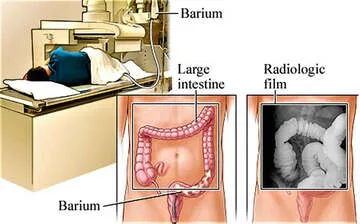
The colon is coated with barium, then inflated with air and images are taken from several different angles. Performed by a radiographer or radiologist.
• The patient lies in the left lateral position on the fluoroscopy table
• The operator may perform a digital rectal examination before beginning
• A rectal tube is placed, attached to a bag of barium sulphate. The barium is run into the colon under x-ray guidance until it reaches the right colon
• The barium is drained
• IV buscopan or, if contraindicated, glucagon is given
• The colon is inflated with air (or with CO, in some centres)
• The patient is instructed to roll and is tilted as images are acquired
• Once the images are obtained, the colon is deflated and the patient can go to the bathroom to empty their bowel and shower if necessary
• The examination may last 15-30 minutes
• The patient should be kept in the department until any medication side effects (e.g. blurred vision) have worn off.
Risks
• Perforation (increased risk in elderly, ulcerating lesions, systemic steroids, hypothyroidism, large bowel obstruction):
• Intraperitoneal barium causes hypovolaemic shock and a 50% mortality. Of those that survive, 30% have adhesions
• Cardiac arrhythmia (secondary to the large bowel distension)
• Medication effects
Patient Preparation
• Iron tablets: stop 5 days before
• Constipating agents: stop 2 days before
• Fasting: low residue diet 2 days before, fluids only on the day before
• Bowel preparation: laxative (usually Picolax® taken at 08:00 and
18:00 on the day before.
Other Information
• Buscopan is given to inhibit intestinal motility. Side effects include blurred vision, dry mouth, and tachycardia:
Contraindicated in angina, untreated closed-angle glaucoma, prostatic hypertrophy, myasthenia gravis, paralytic ileus, and pyloric stenosis
• Glucagon is given if buscopan cannot. Risk of hypersensitivity and is contraindicated in phaeochromocytoma, insulinoma, and glucagonoma
• After the procedure, the patient may eat and drink as usual but is advised to keep their bowel moving to avoid barium impaction
• A barium study will prevent a CT examination of the same area for a period of time as intestinal barium creates dense streak artefact.
Water-Soluble Contrast Examinations
• In the case of recent surgery, suspected perforation, or investigation of a leak, water-based iodinated contrast is used instead of barium.
Examples include Gastrografin®, Urografin®, Niopam®, Omnipaque®
• A single-contrast examination is performed (i.e. the colon is not inflated with air) and many of the standard' views are not included
• No bowel preparation or fasting is needed.
• The following refers to the standard 'double contrast' barium enema.
Indications
• Investigation of colonic pathology. Indications include pain, melaena, anaemia, palpable mass, change in bowel habit, failed colonoscopy, investigation of remaining colon in the case of a known colonic tumour
• • Always consider alternatives (e.g. colonoscopy, CT colonography).
Contraindications
• Absolute: lack of informed consent, possible perforation, pseudomembranous colitis, toxic megacolon, biopsy via rigid sigmoidoscope within 5 days, biopsy via flexible endoscope within 1 day
•Relative: barium meal within 7-14 days, patient frailty or immobility:
• • The procedure requires a large amount of patient cooperation.
The patient must be able to lie flat and to turn over easily
• The patient must be able to retain rectal barium and air.
Procedure
The colon is coated with barium, then inflated with air and images are taken from several different angles. Performed by a radiographer or radiologist.
• The patient lies in the left lateral position on the fluoroscopy table
• The operator may perform a digital rectal examination before beginning
• A rectal tube is placed, attached to a bag of barium sulphate. The barium is run into the colon under x-ray guidance until it reaches the right colon
• The barium is drained
• IV buscopan or, if contraindicated, glucagon is given
• The colon is inflated with air (or with CO, in some centres)
• The patient is instructed to roll and is tilted as images are acquired
• Once the images are obtained, the colon is deflated and the patient can go to the bathroom to empty their bowel and shower if necessary
• The examination may last 15-30 minutes
• The patient should be kept in the department until any medication side effects (e.g. blurred vision) have worn off.
Risks
• Perforation (increased risk in elderly, ulcerating lesions, systemic steroids, hypothyroidism, large bowel obstruction):
• Intraperitoneal barium causes hypovolaemic shock and a 50% mortality. Of those that survive, 30% have adhesions
• Cardiac arrhythmia (secondary to the large bowel distension)
• Medication effects
Patient Preparation
• Iron tablets: stop 5 days before
• Constipating agents: stop 2 days before
• Fasting: low residue diet 2 days before, fluids only on the day before
• Bowel preparation: laxative (usually Picolax® taken at 08:00 and
18:00 on the day before.
Other Information
• Buscopan is given to inhibit intestinal motility. Side effects include blurred vision, dry mouth, and tachycardia:
Contraindicated in angina, untreated closed-angle glaucoma, prostatic hypertrophy, myasthenia gravis, paralytic ileus, and pyloric stenosis
• Glucagon is given if buscopan cannot. Risk of hypersensitivity and is contraindicated in phaeochromocytoma, insulinoma, and glucagonoma
• After the procedure, the patient may eat and drink as usual but is advised to keep their bowel moving to avoid barium impaction
• A barium study will prevent a CT examination of the same area for a period of time as intestinal barium creates dense streak artefact.
Water-Soluble Contrast Examinations
• In the case of recent surgery, suspected perforation, or investigation of a leak, water-based iodinated contrast is used instead of barium.
Examples include Gastrografin®, Urografin®, Niopam®, Omnipaque®
• A single-contrast examination is performed (i.e. the colon is not inflated with air) and many of the standard' views are not included
• No bowel preparation or fasting is needed.
0 Comments
