- Published on
Clinical Procedures – Basic Spirometry
Basic spirometry is a simple lung function test which can aid diagnosis of a number of conditions, but is primarily used to distinguish between restrictive and obstructive lung diseases.
Different spirometers vary in their operation, but most are now hand-held computerized devices with an easy-to-use interface, able to calculate normal values and print a spirometry report. The following describes the use of this device.
Procedure
• Introduce yourself, confirm the patient's identity, explain the procedure, and obtain informed consent
• The patient should be standing or sitting upright
° Input the data requested by the spirometer if appropriate: age, gender, and height
• Ask the patient to take a deep breath and wrap their lips around the mouthpiece, making an airtight seal
• Ask the patient to breathe out as hard and as long as possible until they feel they have completely emptied their lungs
• Three satisfactory breaths should be obtained:
• D The volume-time graph should be smooth, subsequent
FEV1 and FVC results should be within 100mL of each other
• Save and print the report.
Procedure Tips
• If the patient is having difficulty performing correctly, a brief demonstration often proves very useful
• Performing the test seated may be easier for elderly or infirm patients.
Documentation
• Record the FVC, FEV , the FEV/FVC ratio and relevant predicted values. Also document the quality and reproducibility of blows and whether pre- or post-treatment.
Key Values
• FEV: forced expiratory volume in the first second
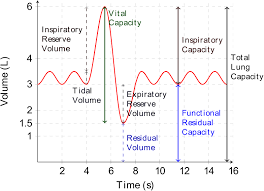
• FVC: forced vital capacity (the total lung volume from maximum inspiration to maximum expiration, in forced exhalation).
Common patterns of abnormality
Obstructive
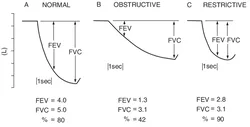
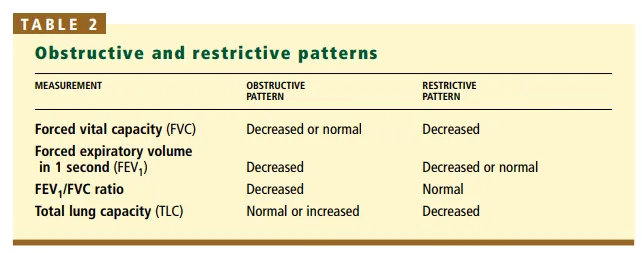
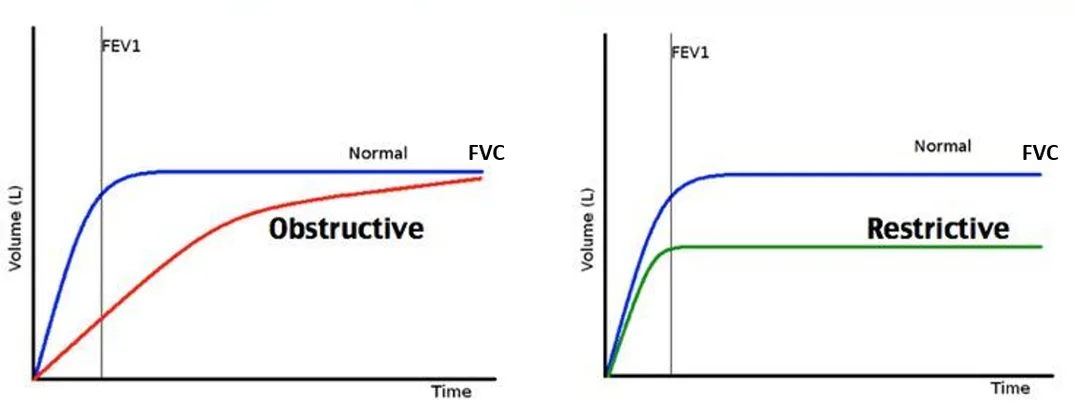
Although FVC may be reduced, FEV is much more reduced, hence the FEV/FVC ratio falls. It can also take much longer to fully exhale
Restrictive
The airway patency is not affected in restrictive lung conditions but the
FEV and FVC are reduced due to the restrictive picture
Basic spirometry is a simple lung function test which can aid diagnosis of a number of conditions, but is primarily used to distinguish between restrictive and obstructive lung diseases.
Different spirometers vary in their operation, but most are now hand-held computerized devices with an easy-to-use interface, able to calculate normal values and print a spirometry report. The following describes the use of this device.
Procedure
• Introduce yourself, confirm the patient's identity, explain the procedure, and obtain informed consent
• The patient should be standing or sitting upright
° Input the data requested by the spirometer if appropriate: age, gender, and height
• Ask the patient to take a deep breath and wrap their lips around the mouthpiece, making an airtight seal
• Ask the patient to breathe out as hard and as long as possible until they feel they have completely emptied their lungs
• Three satisfactory breaths should be obtained:
• D The volume-time graph should be smooth, subsequent
FEV1 and FVC results should be within 100mL of each other
• Save and print the report.
Procedure Tips
• If the patient is having difficulty performing correctly, a brief demonstration often proves very useful
• Performing the test seated may be easier for elderly or infirm patients.
Documentation
• Record the FVC, FEV , the FEV/FVC ratio and relevant predicted values. Also document the quality and reproducibility of blows and whether pre- or post-treatment.
Key Values
• FEV: forced expiratory volume in the first second
• FVC: forced vital capacity (the total lung volume from maximum inspiration to maximum expiration, in forced exhalation).
Common patterns of abnormality
Obstructive
Although FVC may be reduced, FEV is much more reduced, hence the FEV/FVC ratio falls. It can also take much longer to fully exhale
Restrictive
The airway patency is not affected in restrictive lung conditions but the
FEV and FVC are reduced due to the restrictive picture

0 Comments
