- Published on
Clinical Procedures - Capsule Endoscopy
Indications
• Obscure gastrointestinal bleeding (in patients with negative gastroscopy and ileocolonoscopy), known or suspected small bowel Crohn's disease, assessment of coeliac disease, screening and surveillance for polyps in familial polyposis syndromes.
Contraindications
• Lack of informed consent, intestinal strictures, adhesions, obstruction
• Diverticula or fistulae that may block the passage of capsule endoscope
• Cardiac pacemakers or other implanted electronic devices
• Difficulty in swallowing tablets or known swallowing disorders
• Pregnancy (lack of available safety data)
• D Patients with obstructive symptoms or known or suspected inflammatory bowel disease should have either a small bowel follow-through or a patency capsule (dissolves after 36 hours), with an abdominal radiograph taken 24 hours after ingestion to identify whether capsule is retained within small bowel:
• If retained, capsule endoscopy is not appropriate
• D Capsule retention can occur even in the absence of strictures on barium or MR-enteroclysis study.
Procedure
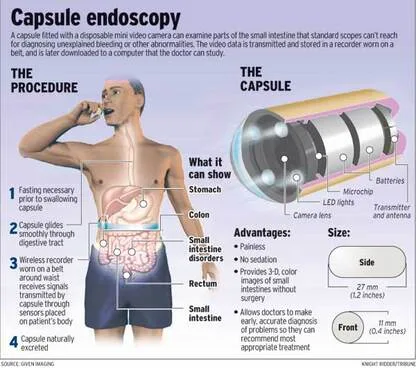
• The capsule consists of a disposable, wireless, miniature video camera which can be swallowed and passes through the intestine by peristalsis
• Images taken by the capsule are transmitted, via sensors secured to the abdominal wall, to a battery-powered data recorder worn on a belt
• The capsule leaves the stomach within 30 minutes and the patient is allowed to drink after 2 hours and eat after 4 hours
• The external equipment is removed after 8 hours (approximate battery life) by which time the capsule has reached the caecum in 85% of cases
• The capsule is expelled naturally after 24 48 hours in the patient's stool
• Data from the recorder is downloaded onto a computer workstation which allows approximately 50,000 images to be viewed as a video.
Risks
• Capsule retention (may cause partial or complete intestinal obstruction; highest risk in patients with extensive small bowel Crohn's disease, chronic usage of non-steroidal anti inflammatory drugs, abdominal radiation injury, previous major abdominal surgery or small bowel resection)
• Capsule endoscopy may also fail in patients with dysphagia, gastroparesis, and anatomical abnormalities of the gastrointestinal tract.
The external equipment which the patient will wear, consisting of a data-recorder and electrodes.
Patient Preparation
• Iron supplements: stop taking 1 week prior to procedure
• Constipating agents: stop 4 days before the procedure
• Fasting: patients are fasted for 8-12 hours prior to the procedure and may receive bowel prep (taken day before procedure).
Other Information
• Incomplete examination in 10-25% of cases:
• Presence of dark intestinal contents in distal small bowel may impair visualization of mucosa
• Delayed gastric emptying and small bowel transit can lead to exhaustion of battery life before capsule reaches ileocaecal valve
• Capsules are being developed to screen for esophageal varices and may be more 'guided' in future as the technology develops
• Positive findings on capsule endoscopy may be reachable using either single- or double-balloon enteroscopy or spiral enteroscopy.
Indications
• Obscure gastrointestinal bleeding (in patients with negative gastroscopy and ileocolonoscopy), known or suspected small bowel Crohn's disease, assessment of coeliac disease, screening and surveillance for polyps in familial polyposis syndromes.
Contraindications
• Lack of informed consent, intestinal strictures, adhesions, obstruction
• Diverticula or fistulae that may block the passage of capsule endoscope
• Cardiac pacemakers or other implanted electronic devices
• Difficulty in swallowing tablets or known swallowing disorders
• Pregnancy (lack of available safety data)
• D Patients with obstructive symptoms or known or suspected inflammatory bowel disease should have either a small bowel follow-through or a patency capsule (dissolves after 36 hours), with an abdominal radiograph taken 24 hours after ingestion to identify whether capsule is retained within small bowel:
• If retained, capsule endoscopy is not appropriate
• D Capsule retention can occur even in the absence of strictures on barium or MR-enteroclysis study.
Procedure
• The capsule consists of a disposable, wireless, miniature video camera which can be swallowed and passes through the intestine by peristalsis
• Images taken by the capsule are transmitted, via sensors secured to the abdominal wall, to a battery-powered data recorder worn on a belt
• The capsule leaves the stomach within 30 minutes and the patient is allowed to drink after 2 hours and eat after 4 hours
• The external equipment is removed after 8 hours (approximate battery life) by which time the capsule has reached the caecum in 85% of cases
• The capsule is expelled naturally after 24 48 hours in the patient's stool
• Data from the recorder is downloaded onto a computer workstation which allows approximately 50,000 images to be viewed as a video.
Risks
• Capsule retention (may cause partial or complete intestinal obstruction; highest risk in patients with extensive small bowel Crohn's disease, chronic usage of non-steroidal anti inflammatory drugs, abdominal radiation injury, previous major abdominal surgery or small bowel resection)
• Capsule endoscopy may also fail in patients with dysphagia, gastroparesis, and anatomical abnormalities of the gastrointestinal tract.
The external equipment which the patient will wear, consisting of a data-recorder and electrodes.
Patient Preparation
• Iron supplements: stop taking 1 week prior to procedure
• Constipating agents: stop 4 days before the procedure
• Fasting: patients are fasted for 8-12 hours prior to the procedure and may receive bowel prep (taken day before procedure).
Other Information
• Incomplete examination in 10-25% of cases:
• Presence of dark intestinal contents in distal small bowel may impair visualization of mucosa
• Delayed gastric emptying and small bowel transit can lead to exhaustion of battery life before capsule reaches ileocaecal valve
• Capsules are being developed to screen for esophageal varices and may be more 'guided' in future as the technology develops
• Positive findings on capsule endoscopy may be reachable using either single- or double-balloon enteroscopy or spiral enteroscopy.
0 Comments
