- Published on
Clinical Procedures - Esophagogastroduodenoscopy
Indications
• Diagnostic: haematemesis, dyspepsia (>55 years old), oesophageal and gastric biopsies (?malignancy), duodenal biopsies (?coeliac), surveillance (e.g. Barrett's oesophagus), persistent nausea and vomiting, iron-deficiency anemia, dysphagia
• Therapeutic: treatment of bleeding lesions, variceal banding and sclerotherapy, stricture dilatation, polypectomy, endoscopic mucosal resection, palliative intent (e.g. stent insertion, laser therapy), argon plasma coagulation for suspected vascular lesions.
Contraindications
• Absolute: lack of informed consent, possible perforation, haemodynamic instability, hypoxaemia with respiratory distress, uncooperative patient
•Relative: pharyngeal diverticulum, recent MI or PE.
Procedure
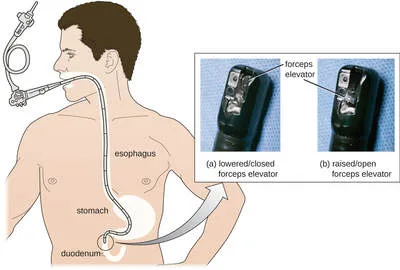
• Endoscopic examination of the mucosa of the esophagus, stomach, and proximal duodenum. Allows direct visualization, mucosal biopsies,
and other therapeutic procedures
• Dentures (if present) are removed
• Patient is given anaesthetic throat spray (lidocaine) ‡ IV sedation (e.g. midazolam)
• Patient lies on the couch in the left lateral position
• Hollow mouthpiece is inserted to protect the patient's teeth and facilitate instrument passage
• Endoscope (9.5-12.5mm diameter, max. 120cm long) is slowly advanced
and swallowed by the patient
• Scope advanced and manipulated by the endoscopist to allow
visualization of the target structures
• Procedure time varies but average 3-15 minutes.
Risks
• Minor throat and abdominal discomfort
• Cardiorespiratory: arrhythmias, MI, respiratory arrest, shock, death
Infection (uncommon, e.g. aspiration pneumonia)
Perforation (around 0.03% with a mortality of 0.001% during diagnostic procedures, higher with therapeutic procedures):
• Overall 2-3% perforation with esophageal dilatation; mortality 1%
• Bleeding (caution with low platelet counts and high INR)
• Medication effects including anaphylactic reactions and oversedation
• Dental trauma.
Patient Preparation
• Fasting: 4 hours prior to the procedure unless in an emergency situation
• Antibiotic prophylaxis: none for OGD. See other topics for comparison.
Other Information
• Dosages of benzodiazepines and opiates should be kept to a minimum
to achieve sedation, with lower doses being prescribed in elderly patients
• The pharynx is sprayed with local anaesthetic spray. There is some evidence that the combination use of local anesthetic spray and IV sedation increases the risk of aspiration pneumonia
• Patients who have had IV sedation should not drive, operate heavy machinery, or drink alcohol for 24 hours afterwards.
Indications
• Diagnostic: haematemesis, dyspepsia (>55 years old), oesophageal and gastric biopsies (?malignancy), duodenal biopsies (?coeliac), surveillance (e.g. Barrett's oesophagus), persistent nausea and vomiting, iron-deficiency anemia, dysphagia
• Therapeutic: treatment of bleeding lesions, variceal banding and sclerotherapy, stricture dilatation, polypectomy, endoscopic mucosal resection, palliative intent (e.g. stent insertion, laser therapy), argon plasma coagulation for suspected vascular lesions.
Contraindications
• Absolute: lack of informed consent, possible perforation, haemodynamic instability, hypoxaemia with respiratory distress, uncooperative patient
•Relative: pharyngeal diverticulum, recent MI or PE.
Procedure
• Endoscopic examination of the mucosa of the esophagus, stomach, and proximal duodenum. Allows direct visualization, mucosal biopsies,
and other therapeutic procedures
• Dentures (if present) are removed
• Patient is given anaesthetic throat spray (lidocaine) ‡ IV sedation (e.g. midazolam)
• Patient lies on the couch in the left lateral position
• Hollow mouthpiece is inserted to protect the patient's teeth and facilitate instrument passage
• Endoscope (9.5-12.5mm diameter, max. 120cm long) is slowly advanced
and swallowed by the patient
• Scope advanced and manipulated by the endoscopist to allow
visualization of the target structures
• Procedure time varies but average 3-15 minutes.
Risks
• Minor throat and abdominal discomfort
• Cardiorespiratory: arrhythmias, MI, respiratory arrest, shock, death
Infection (uncommon, e.g. aspiration pneumonia)
Perforation (around 0.03% with a mortality of 0.001% during diagnostic procedures, higher with therapeutic procedures):
• Overall 2-3% perforation with esophageal dilatation; mortality 1%
• Bleeding (caution with low platelet counts and high INR)
• Medication effects including anaphylactic reactions and oversedation
• Dental trauma.
Patient Preparation
• Fasting: 4 hours prior to the procedure unless in an emergency situation
• Antibiotic prophylaxis: none for OGD. See other topics for comparison.
Other Information
• Dosages of benzodiazepines and opiates should be kept to a minimum
to achieve sedation, with lower doses being prescribed in elderly patients
• The pharynx is sprayed with local anaesthetic spray. There is some evidence that the combination use of local anesthetic spray and IV sedation increases the risk of aspiration pneumonia
• Patients who have had IV sedation should not drive, operate heavy machinery, or drink alcohol for 24 hours afterwards.
0 Comments
