- Published on
Clinical Procedures – Female Urethral Catheterization
Indications
• Relief of acute urinary retention
• Accurate monitoring of urine output in the acutely unwell/ those undergoing surgery
• Prevention of complications of chronic urinary retention (e.g. neurological; consider long-term alternatives)
• Urinary incontinence (consider alternatives e.g. pad).
Contraindications
• Urethral injury.
Risks
• Urinary tract infection
• Septicaemia
• Pain
• Haematuria
• Urethral trauma
• © Beware latex allergy.
Procedure Tips
• Difficulty passing the catheter may be alleviated by slowly rotating the catheter whilst inserting
• Difficulty seeing the urethral meatus may be overcome by asking the patient to 'bear down'
• If urine fails to drain despite the catheter being fully advanced:
• Palpate the bladder: if palpable, the catheter is inappropriately placed
• Manual pressure on the bladder may express enough urine from a near-empty bladder to show itself
• Aspirate with a bladder syringe, or flush with a little sterile saline
• b If it is impossible to pass the catheter, ask for help. If all else fails, it may be necessary to proceed to suprapubic catheterization.
Equipment
• Foley catheter (female of appropriate French, usually
12-14
• 10mL syringe of sterile water
• Syringe of lidocaine gel 1% (e.g. Instilligel®)
• Catheter bag
• Sterile gloves
• Catheter pack containing drape, kidney dish, swabs/cotton balls, and a small dish
• Sterile water/chlorhexidine sachet.
Procedure
• Introduce yourself, confirm the patient's identity, explain the procedure, and obtain informed consent
• Position the patient with hips externally rotated and knees flexed. Uncover from waist down
• Using aseptic technique, unwrap the equipment and pour the chlorhexidine or sterile water into the dish
• Wash your hands and put on the sterile gloves
• Tear a hole in the middle of the drape and place it over the genitals so as to allow access
• Use your non-dominant hand to part the labia
• Clean around the urethral meatus using the water/ chlorhexidine and a swab, moving from the centre of
• Instil local anaesthetic via urethral meatus:
• Wait at least 1 minute for the anaesthetic to act
• Place the kidney bowl between the patient's thighs
• Remove the tip of the plastic sheath containing the catheter, being careful not to touch the catheter itself
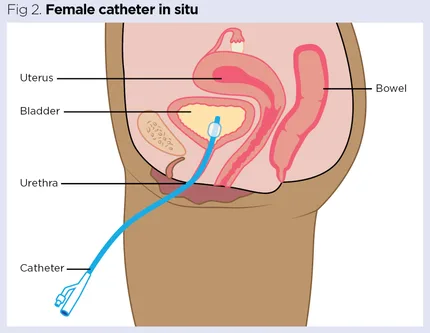
• Insert catheter into urethra, feeding it out of the plastic wrapper as it is advanced
• Insert the catheter to the 'hilt'
• At this point, urine may begin to drain. Let the end of the catheter rest in the kidney bowl to prevent any spills
• Inflate the balloon using sterile water inserted into the catheter side-arm according to the balloon's capacity (written on the cuff of the balloon lumen)
• D Watch the patient's face and ask them to warn you if they feel pain
• Once the balloon is inflated, remove the syringe and attach the catheter bag
• Gently pull the catheter until you feel resistance as the balloon rests against the bladder neck
• Re-dress the patient appropriately.
Documentation
• Date and time
• Indication, informed consent obtained
• Size of catheter inserted
• Aseptic technique used?
• Volume of water used to inflate the balloon
• Residual volume of urine obtained
• Any immediate complications
• Signature, printed name, and contact details.
Indications
• Relief of acute urinary retention
• Accurate monitoring of urine output in the acutely unwell/ those undergoing surgery
• Prevention of complications of chronic urinary retention (e.g. neurological; consider long-term alternatives)
• Urinary incontinence (consider alternatives e.g. pad).
Contraindications
• Urethral injury.
Risks
• Urinary tract infection
• Septicaemia
• Pain
• Haematuria
• Urethral trauma
• © Beware latex allergy.
Procedure Tips
• Difficulty passing the catheter may be alleviated by slowly rotating the catheter whilst inserting
• Difficulty seeing the urethral meatus may be overcome by asking the patient to 'bear down'
• If urine fails to drain despite the catheter being fully advanced:
• Palpate the bladder: if palpable, the catheter is inappropriately placed
• Manual pressure on the bladder may express enough urine from a near-empty bladder to show itself
• Aspirate with a bladder syringe, or flush with a little sterile saline
• b If it is impossible to pass the catheter, ask for help. If all else fails, it may be necessary to proceed to suprapubic catheterization.
Equipment
• Foley catheter (female of appropriate French, usually
12-14
• 10mL syringe of sterile water
• Syringe of lidocaine gel 1% (e.g. Instilligel®)
• Catheter bag
• Sterile gloves
• Catheter pack containing drape, kidney dish, swabs/cotton balls, and a small dish
• Sterile water/chlorhexidine sachet.
Procedure
• Introduce yourself, confirm the patient's identity, explain the procedure, and obtain informed consent
• Position the patient with hips externally rotated and knees flexed. Uncover from waist down
• Using aseptic technique, unwrap the equipment and pour the chlorhexidine or sterile water into the dish
• Wash your hands and put on the sterile gloves
• Tear a hole in the middle of the drape and place it over the genitals so as to allow access
• Use your non-dominant hand to part the labia
• Clean around the urethral meatus using the water/ chlorhexidine and a swab, moving from the centre of
• Instil local anaesthetic via urethral meatus:
• Wait at least 1 minute for the anaesthetic to act
• Place the kidney bowl between the patient's thighs
• Remove the tip of the plastic sheath containing the catheter, being careful not to touch the catheter itself
• Insert catheter into urethra, feeding it out of the plastic wrapper as it is advanced
• Insert the catheter to the 'hilt'
• At this point, urine may begin to drain. Let the end of the catheter rest in the kidney bowl to prevent any spills
• Inflate the balloon using sterile water inserted into the catheter side-arm according to the balloon's capacity (written on the cuff of the balloon lumen)
• D Watch the patient's face and ask them to warn you if they feel pain
• Once the balloon is inflated, remove the syringe and attach the catheter bag
• Gently pull the catheter until you feel resistance as the balloon rests against the bladder neck
• Re-dress the patient appropriately.
Documentation
• Date and time
• Indication, informed consent obtained
• Size of catheter inserted
• Aseptic technique used?
• Volume of water used to inflate the balloon
• Residual volume of urine obtained
• Any immediate complications
• Signature, printed name, and contact details.
0 Comments
