- Published on
Clinical Procedures - Non Invasive Ventilation ( BiPAP)
Non-invasive ventilation should only be set up by experienced operators. The following is a guide only.
Background
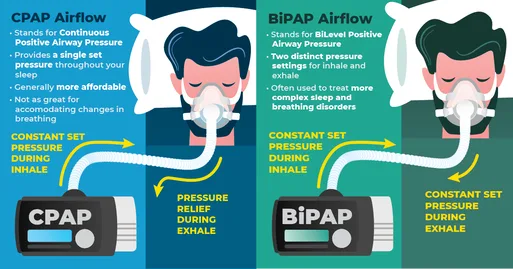
BiPAP = bilevel positive airways pressure. Each machine varies
and some are more complicated than others. The steps outlined below are a guide only. All ventilated patients should be in a ward or unit with specialised staff who have been trained in the use of each ventilator.
Equipment
• Interface (face mask, nasal pillows, nasal mask etc.)
• Head straps
• Ventilation circuit (exhalation port unless on mask
• Humidification (if required)
• Ventilator (NIPPY 1/2/3/3+, BiPAP Vision® etc.)
• Entrained oxygen (unless with ventilator e.g. BiPAP Vision®.
Procedure
• Decide on which interface to use
• Use available templates to assess appropriate sized interface and minimize air leaks
• Start with low pressures (EPAP 4cmH,O, |PAP 12cmHO):
• Slowly increase pressures to levels agreed by multidisciplinary team, for patient comfort and in response to pH, PaO2 and PaCO2
• The aim being to reduce RR and work of breathing normalize ABGs (for the individual) using the minimal pressures possible
• Set inspiratory and expiratory times to those of the patient
• Continually reassess respiratory rates as this will change and therefore set times will have to change
• Titrate oxygen and pressures in response to the patient's saturations, pH, Pa0, and PaCO,
• If appropriate set alarms on ventilator
• Write a prescription chart of ventilation settings and acceptable saturations, Pa02, and PaCO2.
Procedure Tips
• Use full face masks usually in the acute setting as patients are usually mouth-breathing
• Better fit with dentures in!
• Large-bore nasogastric tubes will cause increased leak, change to small-bore or bulk up cheek tissue with granuflex.
Indications
• Type 2 respiratory failure (e.g. exacerbations of COPD, high spinal cord lesions, neuromuscular disease)
• Weaning
• Cardiogenic pulmonary oedema.
Contraindications/Cautions
• D Undrained pneumothorax (absolute contraindication)
• Facial fractures
• Life-threatening epistaxis
• Bullous pulmonary disease
• Proximal lung tumours (air trapping)
• Active TB (spread)
• Acute head injury
• Low blood pressure
• Uncontrolled cardiac arrhythmias
• Sinus/middle ear infection.
Risks
• Abdominal distension (secondary to 'swallowing' air)
• Decreased cardiac output (drop in blood pressure)
• Pressure sores from mask
• Aspiration of vomit
• Pulmonary barotraumas.
Documentation
• Oxygen prescription charts
• Ventilation prescription charts
• Clear record of ABGs with evidence of time, inspired oxygen, and ventilation levels
• Good practice to document the 'ceiling of pressures and FiO2, for the clinical environment.
Non-invasive ventilation should only be set up by experienced operators. The following is a guide only.
Background
BiPAP = bilevel positive airways pressure. Each machine varies
and some are more complicated than others. The steps outlined below are a guide only. All ventilated patients should be in a ward or unit with specialised staff who have been trained in the use of each ventilator.
Equipment
• Interface (face mask, nasal pillows, nasal mask etc.)
• Head straps
• Ventilation circuit (exhalation port unless on mask
• Humidification (if required)
• Ventilator (NIPPY 1/2/3/3+, BiPAP Vision® etc.)
• Entrained oxygen (unless with ventilator e.g. BiPAP Vision®.
Procedure
• Decide on which interface to use
• Use available templates to assess appropriate sized interface and minimize air leaks
• Start with low pressures (EPAP 4cmH,O, |PAP 12cmHO):
• Slowly increase pressures to levels agreed by multidisciplinary team, for patient comfort and in response to pH, PaO2 and PaCO2
• The aim being to reduce RR and work of breathing normalize ABGs (for the individual) using the minimal pressures possible
• Set inspiratory and expiratory times to those of the patient
• Continually reassess respiratory rates as this will change and therefore set times will have to change
• Titrate oxygen and pressures in response to the patient's saturations, pH, Pa0, and PaCO,
• If appropriate set alarms on ventilator
• Write a prescription chart of ventilation settings and acceptable saturations, Pa02, and PaCO2.
Procedure Tips
• Use full face masks usually in the acute setting as patients are usually mouth-breathing
• Better fit with dentures in!
• Large-bore nasogastric tubes will cause increased leak, change to small-bore or bulk up cheek tissue with granuflex.
Indications
• Type 2 respiratory failure (e.g. exacerbations of COPD, high spinal cord lesions, neuromuscular disease)
• Weaning
• Cardiogenic pulmonary oedema.
Contraindications/Cautions
• D Undrained pneumothorax (absolute contraindication)
• Facial fractures
• Life-threatening epistaxis
• Bullous pulmonary disease
• Proximal lung tumours (air trapping)
• Active TB (spread)
• Acute head injury
• Low blood pressure
• Uncontrolled cardiac arrhythmias
• Sinus/middle ear infection.
Risks
• Abdominal distension (secondary to 'swallowing' air)
• Decreased cardiac output (drop in blood pressure)
• Pressure sores from mask
• Aspiration of vomit
• Pulmonary barotraumas.
Documentation
• Oxygen prescription charts
• Ventilation prescription charts
• Clear record of ABGs with evidence of time, inspired oxygen, and ventilation levels
• Good practice to document the 'ceiling of pressures and FiO2, for the clinical environment.
0 Comments
