- Published on
Clinical Procedures – Peripheral Cannulation
Before You Start
Consider:
• Can the drug be given by another route?
• What is the smallest appropriate cannula?
• What is the most appropriate location for the cannula?
Vein Choice
• Avoid areas of skin damage, erythema, or an arm with an AV fistula
• Excessive hair should be cut with scissors before cleaning the skin
• It is best to avoid joint areas such as the antecubital fossa:
• This can cause kinking of the cannula and discomfort
• A straight vein, in an area such as the forearm or dorsum of the hand, where long bones are available to splint the cannula is useful
• Wide-bore access requires siting in large veins and often this is only practicable in the antecubital fossa:
• In practice, especially in patients who have been cannulated many times before, it is often necessary to go wherever you find a vein
Indications
• Drug administration by IV route
• Infusion of fluid or blood.
Contraindications
• Cannulae should not be placed unless IV access is required
• Caution in patients with a bleeding diathesis.
Risks
• Infection, which could be local or systemic.
Procedure Tips
• Local anaesthetic cream may be of benefit if you have time
• Reliable veins are located on the radial aspect of the wrist (*64 antecubital fossa, and anterior to the medial malleolus (long a
• If you fail initially with a large-bore cannula, try a smaller gauge
• If no veins are visible/palpable at first, try warming the limb in want water for a couple of minutes
• It may be useful to get assistance to hold the patient's arm still if they are likely to move it during the procedure
• If you are unable to cannulate after several attempts, try asking someone else. A pair of fresh eyes makes a lot of difference!
Equipment
• Gloves
• Sterile wipe (e.g. chlorhexidine)
• Cannula of appropriate gauge (see next card)
• Sterile saline for iniection ('flush')
• 5mL syringe
• Cannula dressing
• Cotton wool balls/ gauze
• Tourniquet.
Sizing Cannulae
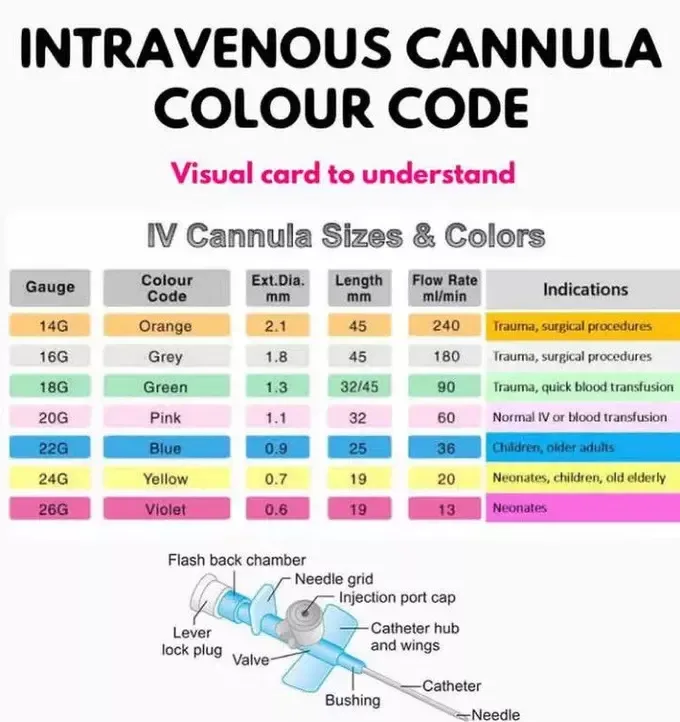
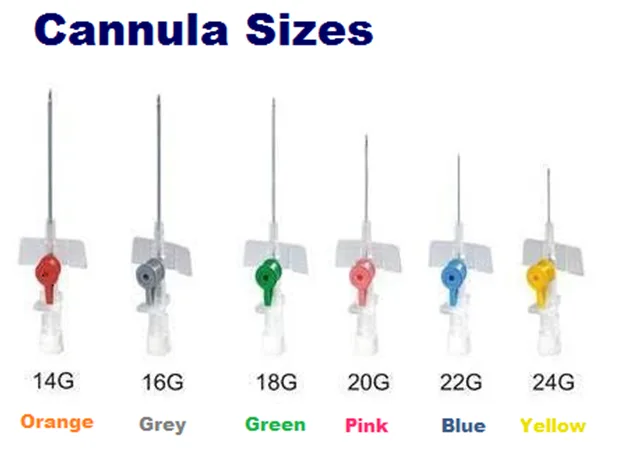
Cannulae are colour-coded according to size. The 'gauge' is inversely proportional to the external diameter.
The standard size cannula is 'green' or 18G but for most hospital patients, a 'pink' or 20G cannula will suffice. Even blue cannulae are adequate in most circumstances unless fast flows of fluid are required.
Procedure
• Introduce yourself, confirm the patient's identity, explain the procedure, and obtain informed consent
• Put the gloves on
• Apply the tourniquet proximally on the limb
• Once the veins are distended, select an appropriate vein: it should be straight for the length of the cannula
• Wipe with sterile wipe, beginning where you intend to insert the cannula and moving outwards in circles
• Whilst the cleaning fluid is drying, fill the syringe with saline and eject any air bubbles
• Remove the dressing from its packaging
• Unwrap the cannula and check that all parts disengage easily. Fold the wings down so that they will lie flat on the skin after insertion
• Using your non-dominant hand, pull the skin taut over the vein in order to anchor it in place
• Hold the cannula with index and middle fingers in fro the cannula wings, thumb behind the cap (see figure overleaf)
• Warn the patient to expect a 'sharp scratch'
• Insert the needle, bevel up, at an angle of 30° to the skin, until a flashback of blood is visible within the chamber of the cannula.
• Advance the needle a small amount (~1mm) further, then advance the cannula into the vein over the needle, whilst keeping the needle stationary
• Release the tourniquet
• Place your non-dominant thumb over the tip of the cannula, compressing the vein, to prevent blood loss whilst you remove the needle completely
• Flush the cannula with a little saline from the end and replace the cap
• Write the date on the cannula dressing and secure in place.
Before You Start
Consider:
• Can the drug be given by another route?
• What is the smallest appropriate cannula?
• What is the most appropriate location for the cannula?
Vein Choice
• Avoid areas of skin damage, erythema, or an arm with an AV fistula
• Excessive hair should be cut with scissors before cleaning the skin
• It is best to avoid joint areas such as the antecubital fossa:
• This can cause kinking of the cannula and discomfort
• A straight vein, in an area such as the forearm or dorsum of the hand, where long bones are available to splint the cannula is useful
• Wide-bore access requires siting in large veins and often this is only practicable in the antecubital fossa:
• In practice, especially in patients who have been cannulated many times before, it is often necessary to go wherever you find a vein
Indications
• Drug administration by IV route
• Infusion of fluid or blood.
Contraindications
• Cannulae should not be placed unless IV access is required
• Caution in patients with a bleeding diathesis.
Risks
• Infection, which could be local or systemic.
Procedure Tips
• Local anaesthetic cream may be of benefit if you have time
• Reliable veins are located on the radial aspect of the wrist (*64 antecubital fossa, and anterior to the medial malleolus (long a
• If you fail initially with a large-bore cannula, try a smaller gauge
• If no veins are visible/palpable at first, try warming the limb in want water for a couple of minutes
• It may be useful to get assistance to hold the patient's arm still if they are likely to move it during the procedure
• If you are unable to cannulate after several attempts, try asking someone else. A pair of fresh eyes makes a lot of difference!
Equipment
• Gloves
• Sterile wipe (e.g. chlorhexidine)
• Cannula of appropriate gauge (see next card)
• Sterile saline for iniection ('flush')
• 5mL syringe
• Cannula dressing
• Cotton wool balls/ gauze
• Tourniquet.
Sizing Cannulae
Cannulae are colour-coded according to size. The 'gauge' is inversely proportional to the external diameter.
The standard size cannula is 'green' or 18G but for most hospital patients, a 'pink' or 20G cannula will suffice. Even blue cannulae are adequate in most circumstances unless fast flows of fluid are required.
Procedure
• Introduce yourself, confirm the patient's identity, explain the procedure, and obtain informed consent
• Put the gloves on
• Apply the tourniquet proximally on the limb
• Once the veins are distended, select an appropriate vein: it should be straight for the length of the cannula
• Wipe with sterile wipe, beginning where you intend to insert the cannula and moving outwards in circles
• Whilst the cleaning fluid is drying, fill the syringe with saline and eject any air bubbles
• Remove the dressing from its packaging
• Unwrap the cannula and check that all parts disengage easily. Fold the wings down so that they will lie flat on the skin after insertion
• Using your non-dominant hand, pull the skin taut over the vein in order to anchor it in place
• Hold the cannula with index and middle fingers in fro the cannula wings, thumb behind the cap (see figure overleaf)
• Warn the patient to expect a 'sharp scratch'
• Insert the needle, bevel up, at an angle of 30° to the skin, until a flashback of blood is visible within the chamber of the cannula.
• Advance the needle a small amount (~1mm) further, then advance the cannula into the vein over the needle, whilst keeping the needle stationary
• Release the tourniquet
• Place your non-dominant thumb over the tip of the cannula, compressing the vein, to prevent blood loss whilst you remove the needle completely
• Flush the cannula with a little saline from the end and replace the cap
• Write the date on the cannula dressing and secure in place.
0 Comments
