- Published on
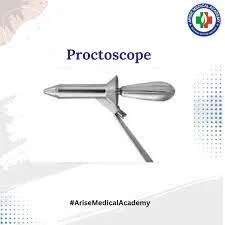
Clinical Procedures - Proctoscopy
Indications
• Rectal bleeding
• Altered bowel habit
• To assess for perianal fistula
• Assessing patient with proctitis.
Contraindications
• Anal stenosis
• Painful perianal area on digital examination
• Pregnancy (relative).
Risks
• Bleeding
• Pain.
Procedure Tips
• Take care while assessing patients with pain (e.g. anal fissure, ischiorectal abscess, fistula):
• Presence of a fissure might prevent further examination due to pain
• Optimal views are obtained if patient has an enema prior to exam but it might not be feasible in all outpatient settings
• Do not biopsy from anal canal lesions as anus is pain-sensitive.
Equipment
• Gloves and other suitable protection (e.g. apron)
• Water-based lubricant gel
• Dry gauze
• Disposable proctoscope set with bellows
• Light source.
Procedure
• Introduce yourself, confirm the patient's identity, explain the procedure, and obtain informed consent
• Ensure a chaperone is available during the examination
• Ask the patient to lie on their left side, flexed at the hips and knees (the Sims position) such that their body lies diagonally across the couch or bed and their buttocks are at the edge of the bed towards you
• Ensure the instrument is assembled (connect the bellows tubing, light source, scope, and eyepiece). Ensure that the tip of the obturator (stylet) protrudes slightly from the end of the scope
• Inspect the anus and perform a digital rectal examination:
• If the rectum is faecally-loaded, this should be emptied (with the use of suppository or enema) before continuing
• Apply lubricant to the tip of the scope
• Insert the scope gently, directed towards the umbilicus
• After insertion, remove the obturator and gently inflate the rectum using the bellows
• With direct visualization, advance slowly as much as possible towards the direction of the lumen, insufflating as you advance
• Remove the scope slowly, examining the mucosa as you do so
• Finally, ask the patient to bear down and look for haemorrhoids or mucosal prolapse
• Once the scope is removed, wipe the perianal area and allow the patient to move to a more comfortable position.
Documentation
• Date, time, informed consent taken.
• Chaperone present.
• Indication (s).
• Depth examined.
• Any abnormalities identified and distance from anal verge.
• Any immediate complications.
• Signature, printed name and contact details.
Indications
• Rectal bleeding
• Altered bowel habit
• To assess for perianal fistula
• Assessing patient with proctitis.
Contraindications
• Anal stenosis
• Painful perianal area on digital examination
• Pregnancy (relative).
Risks
• Bleeding
• Pain.
Procedure Tips
• Take care while assessing patients with pain (e.g. anal fissure, ischiorectal abscess, fistula):
• Presence of a fissure might prevent further examination due to pain
• Optimal views are obtained if patient has an enema prior to exam but it might not be feasible in all outpatient settings
• Do not biopsy from anal canal lesions as anus is pain-sensitive.
Equipment
• Gloves and other suitable protection (e.g. apron)
• Water-based lubricant gel
• Dry gauze
• Disposable proctoscope set with bellows
• Light source.
Procedure
• Introduce yourself, confirm the patient's identity, explain the procedure, and obtain informed consent
• Ensure a chaperone is available during the examination
• Ask the patient to lie on their left side, flexed at the hips and knees (the Sims position) such that their body lies diagonally across the couch or bed and their buttocks are at the edge of the bed towards you
• Ensure the instrument is assembled (connect the bellows tubing, light source, scope, and eyepiece). Ensure that the tip of the obturator (stylet) protrudes slightly from the end of the scope
• Inspect the anus and perform a digital rectal examination:
• If the rectum is faecally-loaded, this should be emptied (with the use of suppository or enema) before continuing
• Apply lubricant to the tip of the scope
• Insert the scope gently, directed towards the umbilicus
• After insertion, remove the obturator and gently inflate the rectum using the bellows
• With direct visualization, advance slowly as much as possible towards the direction of the lumen, insufflating as you advance
• Remove the scope slowly, examining the mucosa as you do so
• Finally, ask the patient to bear down and look for haemorrhoids or mucosal prolapse
• Once the scope is removed, wipe the perianal area and allow the patient to move to a more comfortable position.
Documentation
• Date, time, informed consent taken.
• Chaperone present.
• Indication (s).
• Depth examined.
• Any abnormalities identified and distance from anal verge.
• Any immediate complications.
• Signature, printed name and contact details.
0 Comments
