- Published on
Clinical Procedures – Subcutaneous injection
Subcutaneous injections can be administered at essentially any site with adequate subcutaneous tissue. Usual sites are upper arms and the abdomen, particularly the periumbilical region.
Ensure that you comply with the local policy regarding drug administration. In hospital, two healthcare professionals should usually check and administer medication.
Equipment
• Appropriate syringe (dependent upon quantity of drug to be administered)
• 25G (orange) needle (usually)
• Prescribed drug
• Prescription chart
• Antiseptic swab
• Plaster.
Procedure
• Assess patient for drugs required (i.e. for pain relief, vomiting etc.)
• Refer to prescription chart, double-checking the appropriate drugs and dosage to be given:
• Always ensure you are fully aware of any possible side effects of any drugs you are due to administer
• Double-check the prescription chart for date and appropriate route for administration
• Check administration of previous dose not too soon after last dose?
• Ensure that the drug to be given is within its use-by date
• Check patient and chart for any evidence of allergies, or relevant drug reactions
• Always comply with the local hand-hygiene practices
• Once all above completed as per hospital policy, draw-up required drug and check appropriate needle size
• Complete appropriate documentation
Documentation
• Drugs should always be signed for as per local policy
• Signature and time should be clearly recorded
• Site drug administered
• Reason for drug administration, time given, and any impact on the patient should be recorded in the nursing notes
• Immediate vital signs should be recorded in notes
• Any causes for concern arising from administration of drugs should be clearly documented in the medical notes
• Signature, printed name, and contact details.
• Once checked by suitably qualified staff take drug and prescription chart to the patient
• Introduce yourself, confirm the patient's identity, explain the procedure, and obtain informed consent
• Check with patient: name and date of birth (if capable):
• If incapable, check name band with another healthcare professional
•© The patient may need to be assisted to change position, if unable to move themselves, and to enable access to an appropriate site
• Select appropriate site, and cleanse with the antiseptic wipe
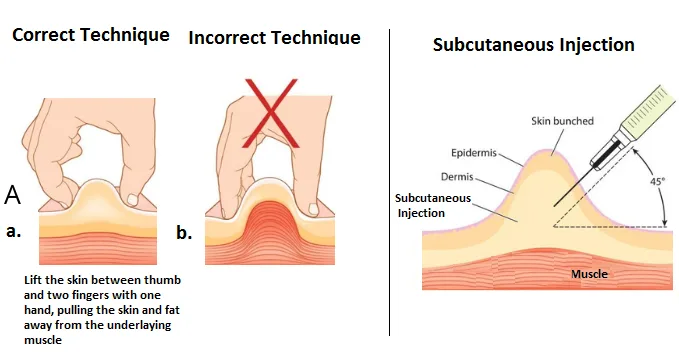
• Grasp skin firmly between thumb and forefinger of your left hand
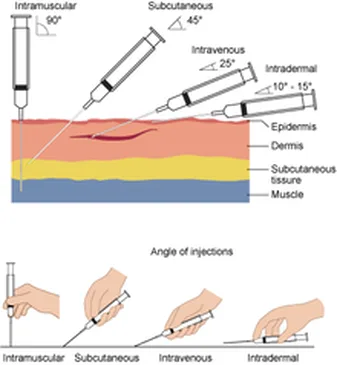
• Insert needle at 45° angle into the pinched skin, then release skin from your grip
• Draw syringe plunger back, checking for any blood. If none, inject drug slowly:
• D If any blood is noted on pulling the plunger back, withdraw and stop procedure provide reassurance and explanation to the patient
• Once the procedure is completed without complication, withdraw needle and discard into a sharps bin
• Monitor patient for any negative effects of the drug.
Subcutaneous injections can be administered at essentially any site with adequate subcutaneous tissue. Usual sites are upper arms and the abdomen, particularly the periumbilical region.
Ensure that you comply with the local policy regarding drug administration. In hospital, two healthcare professionals should usually check and administer medication.
Equipment
• Appropriate syringe (dependent upon quantity of drug to be administered)
• 25G (orange) needle (usually)
• Prescribed drug
• Prescription chart
• Antiseptic swab
• Plaster.
Procedure
• Assess patient for drugs required (i.e. for pain relief, vomiting etc.)
• Refer to prescription chart, double-checking the appropriate drugs and dosage to be given:
• Always ensure you are fully aware of any possible side effects of any drugs you are due to administer
• Double-check the prescription chart for date and appropriate route for administration
• Check administration of previous dose not too soon after last dose?
• Ensure that the drug to be given is within its use-by date
• Check patient and chart for any evidence of allergies, or relevant drug reactions
• Always comply with the local hand-hygiene practices
• Once all above completed as per hospital policy, draw-up required drug and check appropriate needle size
• Complete appropriate documentation
Documentation
• Drugs should always be signed for as per local policy
• Signature and time should be clearly recorded
• Site drug administered
• Reason for drug administration, time given, and any impact on the patient should be recorded in the nursing notes
• Immediate vital signs should be recorded in notes
• Any causes for concern arising from administration of drugs should be clearly documented in the medical notes
• Signature, printed name, and contact details.
• Once checked by suitably qualified staff take drug and prescription chart to the patient
• Introduce yourself, confirm the patient's identity, explain the procedure, and obtain informed consent
• Check with patient: name and date of birth (if capable):
• If incapable, check name band with another healthcare professional
•© The patient may need to be assisted to change position, if unable to move themselves, and to enable access to an appropriate site
• Select appropriate site, and cleanse with the antiseptic wipe
• Grasp skin firmly between thumb and forefinger of your left hand
• Insert needle at 45° angle into the pinched skin, then release skin from your grip
• Draw syringe plunger back, checking for any blood. If none, inject drug slowly:
• D If any blood is noted on pulling the plunger back, withdraw and stop procedure provide reassurance and explanation to the patient
• Once the procedure is completed without complication, withdraw needle and discard into a sharps bin
• Monitor patient for any negative effects of the drug.
0 Comments
