- Published on
Clinical Procedures - Transferring a Patient Laterally Using a Transfer Board
No input from patient. Use this technique to transfer patients who are unable to move themselves.
Equipment
• Patient transfer board or 'Patslide®
Procedure
• There should be at least 3 handlers. Agree who will give commands
• Open transfer board (if folded) and place on bed/trolley you plan to transfer patient to
• Explain the manoeuvre to the patient
• Place destination bed/trolley alongside origin bed/trolley:
• Ensure there is only a minimal gap between the beds/ trolley involved
• Check bed is at waist height to prevent staff injuries
• Staff stand either side of bed/trolley facing each other, 2 people on the 'destination' side and 1 on the other
• Check brakes on bed and trolley secure
• Staff at the patient's bedside to lean over patient and grip bed sheet as close to the patient's body as possible with both hands and roll the patient towards them
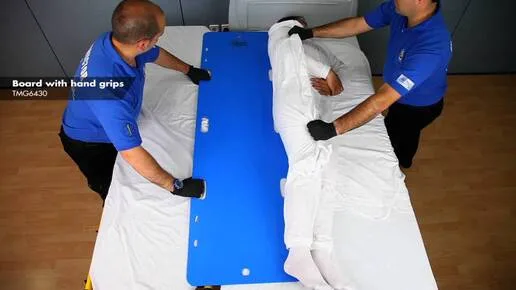
• Staff at the bed/trolley onto which patient is to be transferred, put transfer board onto patient's bed/trolley
• Staff at bed-side allow patient to roll back onto board (which should be under the bed sheet)
• On command of 'Ready, Steady, Move'
• Handlers push and pull patient gently across on transfer board, dependent upon their position:
• Staff should ensure their arms remain straight and they do not lean forward, bending at the waist
• Once patient is transferred, ensure sheets and blankets are comfortably in place
• Bed rails should be put into place as appropriate
Procedure Tips
• Do not rush. Ensure sufficient time is available to safely complete the
manoeuvre
• Ensure the patient and handlers are fully informed regarding steps of the manoeuvre
• Check bed area for any furniture/equipment that could be moved
• Always check IV fluids, catheters, drains, etc. are safe and unlikely to be caught or pulled out during procedure
• Move any attachments onto transferring bed/trolley prior to the move
• Check with qualified staff/physiotherapists regarding any changes in the patient's condition prior to manoeuvre
• Staff should wear suitable (preferably low-heel) footwear and non-restrictive clothing
• Check with ward staff that patient can be laid flat
• If nasogastrically-fed, ensure it is switched off to prevent patient aspirating
• Do not climb onto the bed/trolley. There is a high risk of injury to the handler
Ensure both surfaces are the same height, making the manoeuvre
both easier and more comfortable for the patient.
Risks
• Potential injuries to patient/staff arising from trailing leads and drains
• Disconnection of equipment during manoeuvre
• If the gap between the beds/trolley is too wide, patient may fall through!
Documentation
• All patients should have assessments carried out within 24 hours of admission. Care plan to be maintained/consulted as appropriate
• Any issues or problems with equipment or manoeuvre should be conveyed to the nurse in charge, documented in the notes, and an appropriate incident form completed.
No input from patient. Use this technique to transfer patients who are unable to move themselves.
Equipment
• Patient transfer board or 'Patslide®
Procedure
• There should be at least 3 handlers. Agree who will give commands
• Open transfer board (if folded) and place on bed/trolley you plan to transfer patient to
• Explain the manoeuvre to the patient
• Place destination bed/trolley alongside origin bed/trolley:
• Ensure there is only a minimal gap between the beds/ trolley involved
• Check bed is at waist height to prevent staff injuries
• Staff stand either side of bed/trolley facing each other, 2 people on the 'destination' side and 1 on the other
• Check brakes on bed and trolley secure
• Staff at the patient's bedside to lean over patient and grip bed sheet as close to the patient's body as possible with both hands and roll the patient towards them
• Staff at the bed/trolley onto which patient is to be transferred, put transfer board onto patient's bed/trolley
• Staff at bed-side allow patient to roll back onto board (which should be under the bed sheet)
• On command of 'Ready, Steady, Move'
• Handlers push and pull patient gently across on transfer board, dependent upon their position:
• Staff should ensure their arms remain straight and they do not lean forward, bending at the waist
• Once patient is transferred, ensure sheets and blankets are comfortably in place
• Bed rails should be put into place as appropriate
Procedure Tips
• Do not rush. Ensure sufficient time is available to safely complete the
manoeuvre
• Ensure the patient and handlers are fully informed regarding steps of the manoeuvre
• Check bed area for any furniture/equipment that could be moved
• Always check IV fluids, catheters, drains, etc. are safe and unlikely to be caught or pulled out during procedure
• Move any attachments onto transferring bed/trolley prior to the move
• Check with qualified staff/physiotherapists regarding any changes in the patient's condition prior to manoeuvre
• Staff should wear suitable (preferably low-heel) footwear and non-restrictive clothing
• Check with ward staff that patient can be laid flat
• If nasogastrically-fed, ensure it is switched off to prevent patient aspirating
• Do not climb onto the bed/trolley. There is a high risk of injury to the handler
Ensure both surfaces are the same height, making the manoeuvre
both easier and more comfortable for the patient.
Risks
• Potential injuries to patient/staff arising from trailing leads and drains
• Disconnection of equipment during manoeuvre
• If the gap between the beds/trolley is too wide, patient may fall through!
Documentation
• All patients should have assessments carried out within 24 hours of admission. Care plan to be maintained/consulted as appropriate
• Any issues or problems with equipment or manoeuvre should be conveyed to the nurse in charge, documented in the notes, and an appropriate incident form completed.
0 Comments
