- Published on
Clinical Procedures - Venous Sampling from a Central Venous Catheter
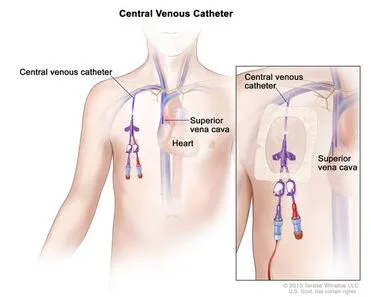
The following describes venous blood sampling from a line in the internal jugular vein. The principles are the same for a line at any site.
Equipment
• 3 × 10mL syringes
• 0.9% isotonic or heparinized saline
• Chlorhexidine or iodine solution
• Sterile gauze
• Sterile gloves and apron
• Sterile drape.
Procedure
• Introduce yourself, confirm the identity of the patient, explain the procedure, and obtain verbal consent
• Stop any infusions (if possible) for at least 1 minute before sampling
• Place the patient in a supine position
• Ask the patient to turn their head away from the line site during the procedure
• Drape the site and put on a pair of sterile gloves and apron
• Spray the line end with the chlorhexidine solution or wipe with gauze dipped in iodine
• Clamp the line port and remove the cap, if present
• Connect a 10mL syringe to the port and then unclamp
• Withdraw 5-10mL of blood, clamp the line and ren syringe
• Discard the blood
• Repeat the procedure with a new syringe, withdrawing tomL.
• Clamp the line, disconnect the syringe. Keep this sample!
• Fill the final syringe with saline and attach it to the port
• Unclamp the port and instil the saline. Clamp the port again before disconnecting the syringe
• Replace the port cap.
Risks
• Clot or infection in the line
• Air embolus
• Physical damage to the line: burst or torn port.
Central venous lines should only be used for blood sampling if it is not possible to obtain a sample via the peripheral route. Do not risk catheter sepsis or a clotted line unless there are no alternatives!
Procedure Tips
• Always be sure to clamp the port before removing the syringe and unclamp before withdrawing blood or instilling the saline
• Most central lines have several ports: which should I use?
• Blood should ideally be sampled from the port with its hole at the tip of the line this is often the brown port
• Check the ports: most will have the gauge printed on them, choose the largest gauge port available
• Be sure to remove any bubbles from the saline before instilling
• Infusions must be stopped: otherwise a significant portion of the sample obtained may be the solution that is entering via the other port giving inaccurate results at analysis!
The following describes venous blood sampling from a line in the internal jugular vein. The principles are the same for a line at any site.
Equipment
• 3 × 10mL syringes
• 0.9% isotonic or heparinized saline
• Chlorhexidine or iodine solution
• Sterile gauze
• Sterile gloves and apron
• Sterile drape.
Procedure
• Introduce yourself, confirm the identity of the patient, explain the procedure, and obtain verbal consent
• Stop any infusions (if possible) for at least 1 minute before sampling
• Place the patient in a supine position
• Ask the patient to turn their head away from the line site during the procedure
• Drape the site and put on a pair of sterile gloves and apron
• Spray the line end with the chlorhexidine solution or wipe with gauze dipped in iodine
• Clamp the line port and remove the cap, if present
• Connect a 10mL syringe to the port and then unclamp
• Withdraw 5-10mL of blood, clamp the line and ren syringe
• Discard the blood
• Repeat the procedure with a new syringe, withdrawing tomL.
• Clamp the line, disconnect the syringe. Keep this sample!
• Fill the final syringe with saline and attach it to the port
• Unclamp the port and instil the saline. Clamp the port again before disconnecting the syringe
• Replace the port cap.
Risks
• Clot or infection in the line
• Air embolus
• Physical damage to the line: burst or torn port.
Central venous lines should only be used for blood sampling if it is not possible to obtain a sample via the peripheral route. Do not risk catheter sepsis or a clotted line unless there are no alternatives!
Procedure Tips
• Always be sure to clamp the port before removing the syringe and unclamp before withdrawing blood or instilling the saline
• Most central lines have several ports: which should I use?
• Blood should ideally be sampled from the port with its hole at the tip of the line this is often the brown port
• Check the ports: most will have the gauge printed on them, choose the largest gauge port available
• Be sure to remove any bubbles from the saline before instilling
• Infusions must be stopped: otherwise a significant portion of the sample obtained may be the solution that is entering via the other port giving inaccurate results at analysis!
0 Comments
