- Published on
Pathology -Accelerated Idioventricular Rhythm
Pathophysiology
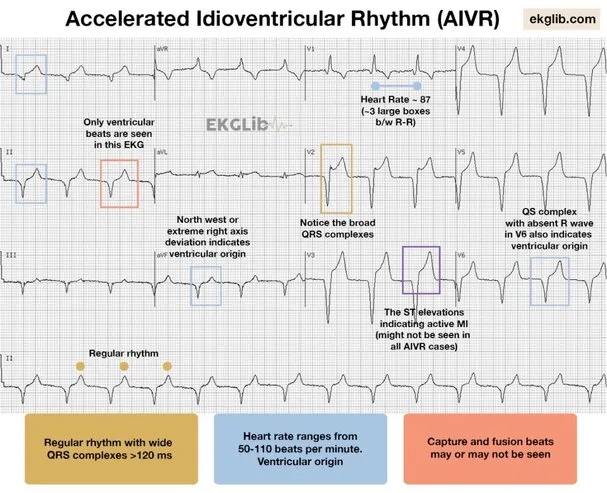
The ventricles cause this arrhythmia, which happens when a typically suppressed ventricular "pacemaker" takes over as the primary heart rate regulator rather than the SA or AV nodes. When the intrinsic ventricular rate (IVR) reaches more than 40 beats per minute, the idioventricular rhythm is deemed to be "accelerated." As in the case vignette, the most frequent situation for this to happen is following coronary reperfusion, or the restoration of flow to ischemic heart tissue. Treatment is not necessary for this benign illness, which is typically invisible to the patient. After receiving reperfusion treatment, normal SA node function usually restores in 24 to 48 hours. ECG monitoring is essential because the illness must be distinguished from ventricular tachycardia, which can develop into the potentially fatal arrhythmia ventricular fibrillation. Idioventricular rhythm occurs at a rate of less than 120 beats per minute, more frequently at a rate of less than 100. Ventricular tachycardia typically occurs at a rate much higher than 120 beats per minute.
Pathophysiology
The ventricles cause this arrhythmia, which happens when a typically suppressed ventricular "pacemaker" takes over as the primary heart rate regulator rather than the SA or AV nodes. When the intrinsic ventricular rate (IVR) reaches more than 40 beats per minute, the idioventricular rhythm is deemed to be "accelerated." As in the case vignette, the most frequent situation for this to happen is following coronary reperfusion, or the restoration of flow to ischemic heart tissue. Treatment is not necessary for this benign illness, which is typically invisible to the patient. After receiving reperfusion treatment, normal SA node function usually restores in 24 to 48 hours. ECG monitoring is essential because the illness must be distinguished from ventricular tachycardia, which can develop into the potentially fatal arrhythmia ventricular fibrillation. Idioventricular rhythm occurs at a rate of less than 120 beats per minute, more frequently at a rate of less than 100. Ventricular tachycardia typically occurs at a rate much higher than 120 beats per minute.
0 Comments
