- Published on
Pathology - Acute Tubular Necrosis
Pathophysiology
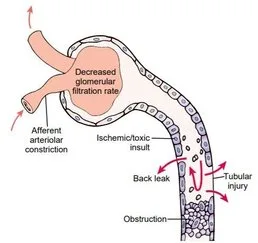
A femur fracture has caused hemorrhage and hypovolemia, which went untreated for several hours. This has resulted in renal ischemia, a protracted reduction in renal perfusion, and tubular cell damage, also known as ATN. In the most active tubules of the proximal tubules and thick ascending limb, ischemic damage first results in ATP depletion. Damage to endothelial cells results in the release of local vasoconstrictors. By compressing capillaries, vascular permeability increases and interstitial pressure rises, further limiting local blood flow.
As a result, even after reperfusion starts, the initial ischemia injury persists. The high fractional sodium excretion (usually only 1-2% of filtered sodium is expelled) is indicative of a tubular damage diagnosis.
Additionally, muddy-brown casts made of tubular epithelial cells can be found in urine sediment. Certain nephrotoxins, such as aminoglycoside antibiotics, radiocontrast medium, and NSAIDs, are other causes of ATN. ATN falls under the category of "intrinsic" AKI, which denotes that damage to a kidney's structural component is the cause of the issue.
Pathophysiology
A femur fracture has caused hemorrhage and hypovolemia, which went untreated for several hours. This has resulted in renal ischemia, a protracted reduction in renal perfusion, and tubular cell damage, also known as ATN. In the most active tubules of the proximal tubules and thick ascending limb, ischemic damage first results in ATP depletion. Damage to endothelial cells results in the release of local vasoconstrictors. By compressing capillaries, vascular permeability increases and interstitial pressure rises, further limiting local blood flow.
As a result, even after reperfusion starts, the initial ischemia injury persists. The high fractional sodium excretion (usually only 1-2% of filtered sodium is expelled) is indicative of a tubular damage diagnosis.
Additionally, muddy-brown casts made of tubular epithelial cells can be found in urine sediment. Certain nephrotoxins, such as aminoglycoside antibiotics, radiocontrast medium, and NSAIDs, are other causes of ATN. ATN falls under the category of "intrinsic" AKI, which denotes that damage to a kidney's structural component is the cause of the issue.
0 Comments
