- Published on
Pathology - Amaurosis Fugax
Pathophysiology
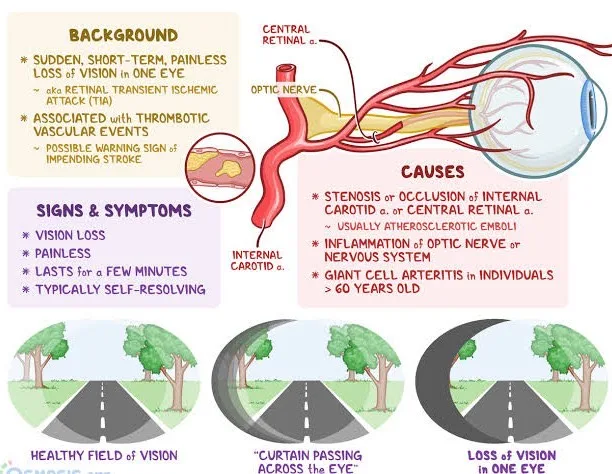
Amaurosis fugax is a temporary, unilateral blindness.
He has a number of risk factors, including hypertension, diabetes, hyperlipidemia, and tobacco use, which indicate the underlying problem of atherosclerosis.
LDL molecules accumulate and oxidize inside the vessel wall over time, triggering an inflammatory reaction. The oxidized LDL is phagocytosed by macrophages, resulting in foam cells that have the potential to burst and intensify inflammation. The vessel thickens as a result, forming a membrane to seal off the inflammatory process. This contributes to the physical examination finding of a carotid bruit by decreasing the luminal width of the vessel and increasing the velocity of blood flow through that location. Ruptures of the carotid atherosclerotic plaque have the potential to induce stroke by releasing emboli into the cerebral circulation. In the event of amaurosis fugax, the emboli may only momentarily obstruct a vessel, such as the ciliary, ophthalmic, or retinal arteries. Amaurosis fugax can have numerous different causes, such as temporal arteritis and hypercoagulable conditions. It is crucial to keep in mind that individuals suffering with amaurosis fugax have a heightened likelihood of experiencing a stroke.
Pathophysiology
Amaurosis fugax is a temporary, unilateral blindness.
He has a number of risk factors, including hypertension, diabetes, hyperlipidemia, and tobacco use, which indicate the underlying problem of atherosclerosis.
LDL molecules accumulate and oxidize inside the vessel wall over time, triggering an inflammatory reaction. The oxidized LDL is phagocytosed by macrophages, resulting in foam cells that have the potential to burst and intensify inflammation. The vessel thickens as a result, forming a membrane to seal off the inflammatory process. This contributes to the physical examination finding of a carotid bruit by decreasing the luminal width of the vessel and increasing the velocity of blood flow through that location. Ruptures of the carotid atherosclerotic plaque have the potential to induce stroke by releasing emboli into the cerebral circulation. In the event of amaurosis fugax, the emboli may only momentarily obstruct a vessel, such as the ciliary, ophthalmic, or retinal arteries. Amaurosis fugax can have numerous different causes, such as temporal arteritis and hypercoagulable conditions. It is crucial to keep in mind that individuals suffering with amaurosis fugax have a heightened likelihood of experiencing a stroke.
0 Comments
