- Published on
Pathology - Atrial Fibrillation
Pathophysiology
As seen in the following example, this rather typical arrhythmia frequently begins with a subacute episode. This disruption of rhythm might be continuous or sporadic (paroxysmal). Breathlessness and palpitations are commonly observed. Laminar flow throughout the heart is disrupted by ineffective atrial contraction, which has multiple effects.
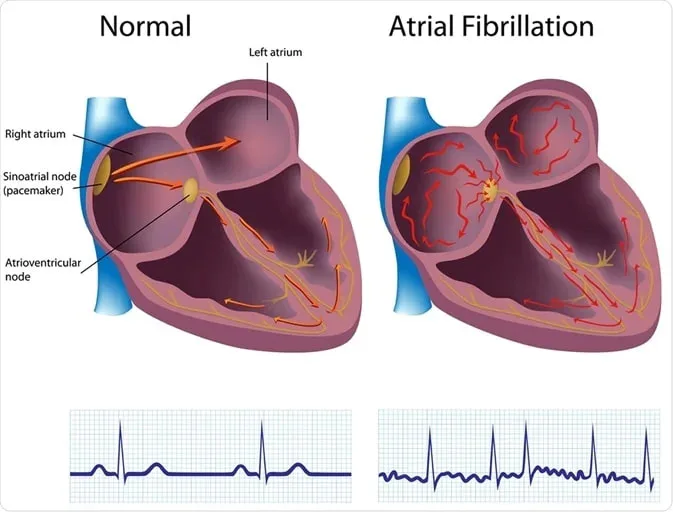
An inefficient flow can result in "stagnant" cardiac circulation, which puts the patient at risk for stroke and pulmonary embolus as well as atrial blood clots. The erratic and frequently quick ventricular response to erratic atrial activity results in dyspnea. An inadequate forward flow of blood to the systemic circulation results from ineffective ventricular pumping. Although various cardiac or pulmonary diseases might cause this illness, hypertension or valvular heart disease are the most common risk factors. The atrioventricular (AV) node is stimulated rapidly and randomly, leading to an abnormally irregular pattern of QRS complexes and the absence of P waves that make the diagnosis of atrial fibrillation easy to make.
Pathophysiology
As seen in the following example, this rather typical arrhythmia frequently begins with a subacute episode. This disruption of rhythm might be continuous or sporadic (paroxysmal). Breathlessness and palpitations are commonly observed. Laminar flow throughout the heart is disrupted by ineffective atrial contraction, which has multiple effects.
An inefficient flow can result in "stagnant" cardiac circulation, which puts the patient at risk for stroke and pulmonary embolus as well as atrial blood clots. The erratic and frequently quick ventricular response to erratic atrial activity results in dyspnea. An inadequate forward flow of blood to the systemic circulation results from ineffective ventricular pumping. Although various cardiac or pulmonary diseases might cause this illness, hypertension or valvular heart disease are the most common risk factors. The atrioventricular (AV) node is stimulated rapidly and randomly, leading to an abnormally irregular pattern of QRS complexes and the absence of P waves that make the diagnosis of atrial fibrillation easy to make.
0 Comments
