- Published on
Pathology - Benign Tumors of the Breast
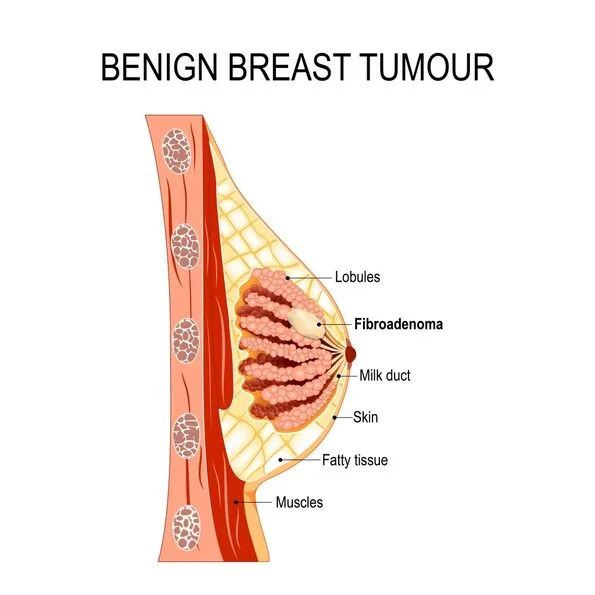
Fibroadenoma (FA): Common in women under 40, more prevalent in African American women at a younger age.
Phyllodes tumor (PT) typically develops in individuals over the age of 50.
Intraductal papilloma (IP) typically affects women in their middle age.
FA: Gross: tiny, mobile, springy, hard mass with distinct, well-defined edges.
Microscopic description: fibroblastic stroma surrounds cystic and glandular areas; may decrease in size after menopause and show calcifications.
PT: Gross: substantial, bulky accumulation of connective tissue and cysts. Microscopic examination reveals cystic areas on the cut piece of stroma including leaflike extensions from cyst walls, resulting in a leaflike appearance on the breast surface. Approximately 5%-10% of these cases progress malignant transformation with atypia, known as cystosarcoma phyllodes.
IP: Gross: originating from significant lactiferous ducts. Microscopic description: increased development of ductal epithelial tissue in a papillary pattern; presence of apocrine metaplasia.
FA and PT: Enlarged mass becomes more sensitive during pregnancy or menstrual cycle; no changes in skin appearance; no swollen lymph nodes; no nipple retraction.
IP: Exhibits nipple discharge.
FA: No intervention or basic removal.
PT: Local excision with broad margin; may return post-resection. IP: Basic removal.
PT and IP are associated with a slightly elevated risk of breast cancer.
Fibroadenoma (FA): Common in women under 40, more prevalent in African American women at a younger age.
Phyllodes tumor (PT) typically develops in individuals over the age of 50.
Intraductal papilloma (IP) typically affects women in their middle age.
FA: Gross: tiny, mobile, springy, hard mass with distinct, well-defined edges.
Microscopic description: fibroblastic stroma surrounds cystic and glandular areas; may decrease in size after menopause and show calcifications.
PT: Gross: substantial, bulky accumulation of connective tissue and cysts. Microscopic examination reveals cystic areas on the cut piece of stroma including leaflike extensions from cyst walls, resulting in a leaflike appearance on the breast surface. Approximately 5%-10% of these cases progress malignant transformation with atypia, known as cystosarcoma phyllodes.
IP: Gross: originating from significant lactiferous ducts. Microscopic description: increased development of ductal epithelial tissue in a papillary pattern; presence of apocrine metaplasia.
FA and PT: Enlarged mass becomes more sensitive during pregnancy or menstrual cycle; no changes in skin appearance; no swollen lymph nodes; no nipple retraction.
IP: Exhibits nipple discharge.
FA: No intervention or basic removal.
PT: Local excision with broad margin; may return post-resection. IP: Basic removal.
PT and IP are associated with a slightly elevated risk of breast cancer.
0 Comments
