- Published on
Pathology - Brown-Séquard Syndrome
Pathophysiology
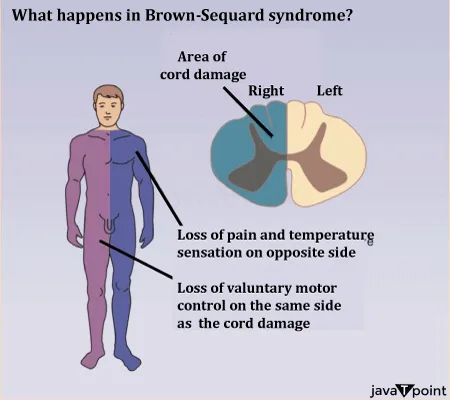
Hemisection of the spinal cord laterally causes Brown-Séquard syndrome. The corticospinal tract fibers, which decussate at the level of the medulla, are severed, resulting in paralysis. The dorsal column/medial lemniscal route is severed, and this leads to a decrease in vibration and proprioception. The pathway also decusses at the medulla level. Severing the spinothalamic tract at the point where it enters the spinal cord causes a reduction in pain perception. This results in the ipsilateral paralysis, reduced vibration/proprioception, and contralateral loss of pain/temperature sensation, which are the hallmark signs of Brown-Séquard syndrome.
Pathophysiology
Hemisection of the spinal cord laterally causes Brown-Séquard syndrome. The corticospinal tract fibers, which decussate at the level of the medulla, are severed, resulting in paralysis. The dorsal column/medial lemniscal route is severed, and this leads to a decrease in vibration and proprioception. The pathway also decusses at the medulla level. Severing the spinothalamic tract at the point where it enters the spinal cord causes a reduction in pain perception. This results in the ipsilateral paralysis, reduced vibration/proprioception, and contralateral loss of pain/temperature sensation, which are the hallmark signs of Brown-Séquard syndrome.
0 Comments
