- Published on
Pathology - Cardiac Tamponade
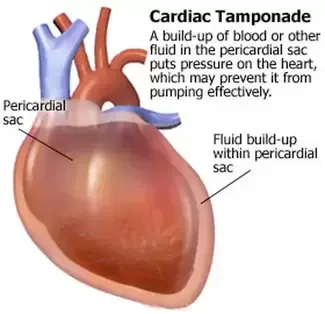
Hemopericardium, which is the collection of blood in the pericardial sac, can be caused by traumatic perforation of the heart or aorta, as well as cardiac rupture resulting from acute myocardial infarction or aortic dissection. May also arise due to the buildup of inflammatory effusions in the pericardial cavity, which can be caused by cancer, connective tissue problems, or infections.
When the heart is compressed, it limits the amount of blood that can fill the heart and equalizes the pressure in its chambers. This results to a decrease in the amount of blood pumped out by the heart, known as cardiac output.
The patient exhibits the Beck triad, which includes hypotension, distant heart sounds, and elevated venous pressure. Additionally, there is pulsus paradoxus, cyanosis, and Kussmaul sign, characterized by a rise in jugular venous pressure with inspiration. If left untreated, this condition can be life-threatening.
Laboratory results: Electrical alternans on an electrocardiogram (ECG) refers to the fluctuation in the height of the QRS complex from one heartbeat to another. Increased size of the heart on chest X-ray
Treatment: Prompt pericardiocentesis: administration of fluids to increase volume.
Hemopericardium, which is the collection of blood in the pericardial sac, can be caused by traumatic perforation of the heart or aorta, as well as cardiac rupture resulting from acute myocardial infarction or aortic dissection. May also arise due to the buildup of inflammatory effusions in the pericardial cavity, which can be caused by cancer, connective tissue problems, or infections.
When the heart is compressed, it limits the amount of blood that can fill the heart and equalizes the pressure in its chambers. This results to a decrease in the amount of blood pumped out by the heart, known as cardiac output.
The patient exhibits the Beck triad, which includes hypotension, distant heart sounds, and elevated venous pressure. Additionally, there is pulsus paradoxus, cyanosis, and Kussmaul sign, characterized by a rise in jugular venous pressure with inspiration. If left untreated, this condition can be life-threatening.
Laboratory results: Electrical alternans on an electrocardiogram (ECG) refers to the fluctuation in the height of the QRS complex from one heartbeat to another. Increased size of the heart on chest X-ray
Treatment: Prompt pericardiocentesis: administration of fluids to increase volume.
0 Comments
