- Published on
Pathology: Charcot-Marie-Tooth Disease
The results stem from a mutation in one of the genes related to nerve myelination and function. Various types of the disease exhibit distinct inheritance patterns and associated mutations.
Typically manifests at age 20, but the age of onset varies depending on the type of sickness.
Pathology
Manifestation: Peripheral nerves enlargement; spinal cord posterior columns degeneration.
Microscopic findings show a "onion bulb" appearance of nerves due to many episodes of demyelination and remyelination, together with Schwann cell hyperplasia.
Pathophysiology: Mutations cause irregular myelin production, leading to demyelination and reduced nerve conduction speed. Schwann cells proliferate and remyelinate segments affected by demyelination.
The specific presentation varies depending on the particular form of the disease. However, typical symptoms include gradual weakening of the muscles in the limbs furthest from the torso, resulting in conditions such as foot drop, unsteady walking, deteriorating handwriting, and muscular spasms.
The physical examination reveals pes cavus deformity (high arch), "stork leg" deformity (due to calf muscle atrophy), scoliosis, reduced deep tendon reflexes, diminished sensibility to vibration and proprioception, and tremor.
Treatment of neuropathies, corrective surgery for joint abnormalities if necessary, and genetic counseling.
Charcot-Marie-Tooth disease is the most prevalent hereditary neurological condition.
The results stem from a mutation in one of the genes related to nerve myelination and function. Various types of the disease exhibit distinct inheritance patterns and associated mutations.
Typically manifests at age 20, but the age of onset varies depending on the type of sickness.
Pathology
Manifestation: Peripheral nerves enlargement; spinal cord posterior columns degeneration.
Microscopic findings show a "onion bulb" appearance of nerves due to many episodes of demyelination and remyelination, together with Schwann cell hyperplasia.
Pathophysiology: Mutations cause irregular myelin production, leading to demyelination and reduced nerve conduction speed. Schwann cells proliferate and remyelinate segments affected by demyelination.
The specific presentation varies depending on the particular form of the disease. However, typical symptoms include gradual weakening of the muscles in the limbs furthest from the torso, resulting in conditions such as foot drop, unsteady walking, deteriorating handwriting, and muscular spasms.
The physical examination reveals pes cavus deformity (high arch), "stork leg" deformity (due to calf muscle atrophy), scoliosis, reduced deep tendon reflexes, diminished sensibility to vibration and proprioception, and tremor.
Treatment of neuropathies, corrective surgery for joint abnormalities if necessary, and genetic counseling.
Charcot-Marie-Tooth disease is the most prevalent hereditary neurological condition.
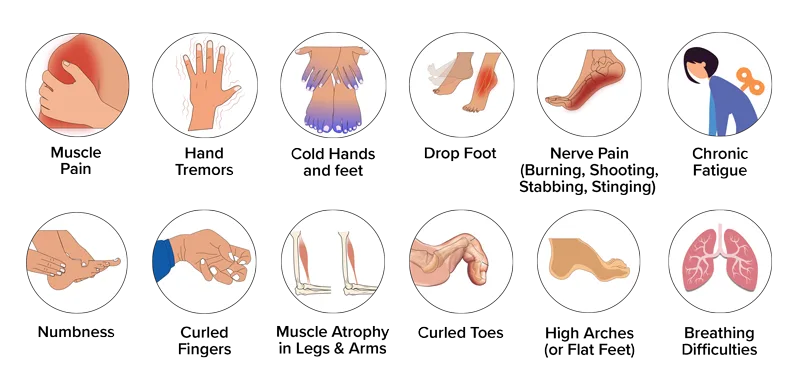
Symptoms and Signs of Charcot - Marie- Tooth Disease
0 Comments
