- Published on
Pathology - Choledocholithiasis
Pathophysiology
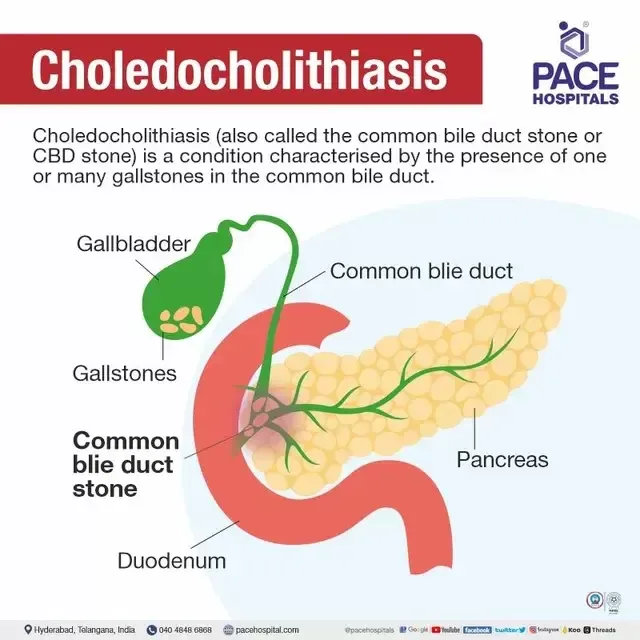
Acute hepatic dysfunction is the result of gallstones becoming stuck in the CBD. The majority of the time, stones move from the gallbladder (cholesterol stones), but any illness that causes biliary stasis, such as hemolytic anemia (pigment stones), can also cause stones to form in the bile duct from scratch. This patient's laboratory tests show insufficient bilirubin excretion. The results show a significant increase in both alkaline phosphatase and direct bilirubin, which is indicative of biliary tract obstruction. Merely slight elevations in AST and ALT suggest a minimal level of hepatocellular involvement. Choledocholithiasis is more common in people over 40; risk factors include obesity, cholelithiasis, exposure to estrogen, and pancreatitis. An additional worry that can point to an infection is the patient's elevated neutrophil fraction. Fever, jaundice, and discomfort in the right upper quadrant are the hallmarks of chol-angitis, an infection of the bile ducts that can develop as a consequence of choledocholithiasis (Charcot's triangle).
Pathophysiology
Acute hepatic dysfunction is the result of gallstones becoming stuck in the CBD. The majority of the time, stones move from the gallbladder (cholesterol stones), but any illness that causes biliary stasis, such as hemolytic anemia (pigment stones), can also cause stones to form in the bile duct from scratch. This patient's laboratory tests show insufficient bilirubin excretion. The results show a significant increase in both alkaline phosphatase and direct bilirubin, which is indicative of biliary tract obstruction. Merely slight elevations in AST and ALT suggest a minimal level of hepatocellular involvement. Choledocholithiasis is more common in people over 40; risk factors include obesity, cholelithiasis, exposure to estrogen, and pancreatitis. An additional worry that can point to an infection is the patient's elevated neutrophil fraction. Fever, jaundice, and discomfort in the right upper quadrant are the hallmarks of chol-angitis, an infection of the bile ducts that can develop as a consequence of choledocholithiasis (Charcot's triangle).
0 Comments
