- Published on
Pathology - Chronic Aortic Regurgitation
Pathophysiology
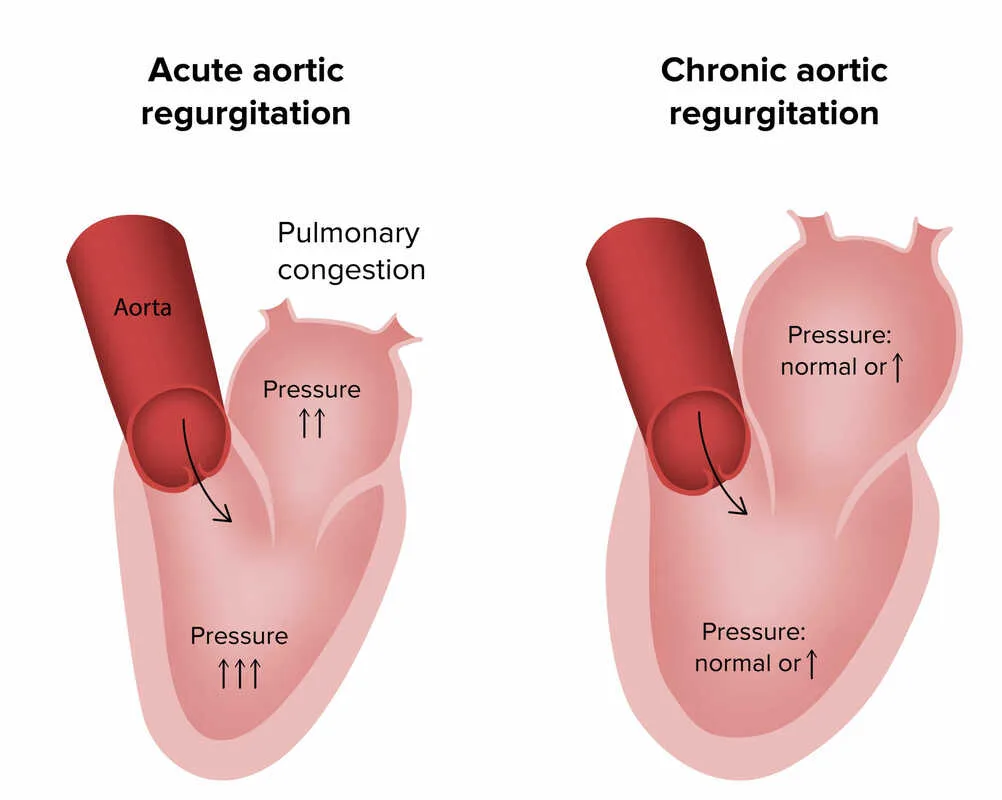
The early diastolic murmur, which is peculiar to diastole and has a decrescendo nature consistent with the pressure gradient across the valve, is produced by blood flow from the aorta to the left ventricle. The progressive dilation of the left ventricle, also known as eccentric hypertrophy, can be seen on a chest radiograph and identified as a left axis deviation on an ECG over time. Over time, ventricular compliance rises to support the additional preload caused by regurgitant blood flow.
This frequently stops the left ventricle and atrium's diastolic pressures from rising significantly, preventing the development of pulmonary edema. On the other hand, dyspnea during exertion and tiredness suggests that the disease process is now compromising forward flow to the systemic circulation. Because of the overly high preload, the high arterial systolic blood pressure indicates a big stoke volume. The pathologic run-off of blood from the aorta into the left ventricle causes the low diastolic blood pressure; the ensuing very big pulse pressure accounts for the head bobbing and bounding pulses observed during systole.
Pathophysiology
The early diastolic murmur, which is peculiar to diastole and has a decrescendo nature consistent with the pressure gradient across the valve, is produced by blood flow from the aorta to the left ventricle. The progressive dilation of the left ventricle, also known as eccentric hypertrophy, can be seen on a chest radiograph and identified as a left axis deviation on an ECG over time. Over time, ventricular compliance rises to support the additional preload caused by regurgitant blood flow.
This frequently stops the left ventricle and atrium's diastolic pressures from rising significantly, preventing the development of pulmonary edema. On the other hand, dyspnea during exertion and tiredness suggests that the disease process is now compromising forward flow to the systemic circulation. Because of the overly high preload, the high arterial systolic blood pressure indicates a big stoke volume. The pathologic run-off of blood from the aorta into the left ventricle causes the low diastolic blood pressure; the ensuing very big pulse pressure accounts for the head bobbing and bounding pulses observed during systole.
0 Comments
