- Published on
Pathology - Closed Angle Glaucoma
Pathophysiology
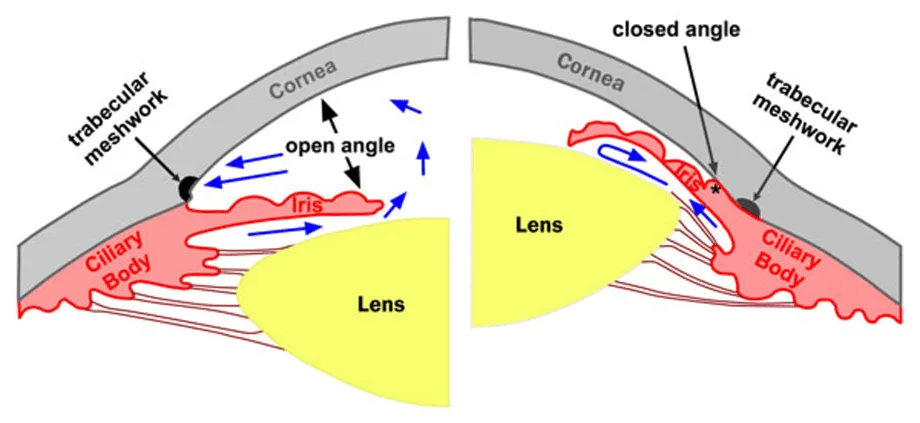
When the iris dilates in patients with narrow angles, or in dimly lit environments, the iris and lens come into touch. The ciliary body continues to produce aqueous humor, but it cannot move from the posterior chamber into the anterior. A rapid increase in intraocular pressure results in conjunctival erythema, lacrimation, and discomfort. Patients may feel queasy, throw up, or have headaches. Halos around lights and diminished visual acuity are examples of visual abnormalities that could quickly lead to total blindness. In narrow-angle glaucoma, intraocular pressures usually surpass 40 mm Hg, although normal intraocular pressures are usually less than 20 mm Hg. This condition is an ophthalmological emergency that needs to be treated right away with acetazolamide, topical beta-blockers, steroids, and reduction of intraocular pressure in order to control inflammation.
Pathophysiology
When the iris dilates in patients with narrow angles, or in dimly lit environments, the iris and lens come into touch. The ciliary body continues to produce aqueous humor, but it cannot move from the posterior chamber into the anterior. A rapid increase in intraocular pressure results in conjunctival erythema, lacrimation, and discomfort. Patients may feel queasy, throw up, or have headaches. Halos around lights and diminished visual acuity are examples of visual abnormalities that could quickly lead to total blindness. In narrow-angle glaucoma, intraocular pressures usually surpass 40 mm Hg, although normal intraocular pressures are usually less than 20 mm Hg. This condition is an ophthalmological emergency that needs to be treated right away with acetazolamide, topical beta-blockers, steroids, and reduction of intraocular pressure in order to control inflammation.
0 Comments
