- Published on
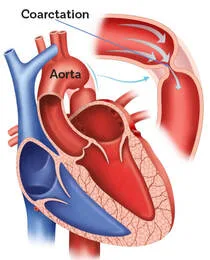
Pathology - Coarctation of Aorta
Etiology unknown: linked with Turner syndrome (infantile form)
More prevalent among males.
Study of the nature and causes of diseases.
Infantile type: Constriction of the aorta occurring before the ductus arteriosus.
Adult type: Aortic stenosis occurring after the ductus arteriosus
Both categories may be accompanied with bicuspid aortic valve, aortic stenosis, atrial septal defect (ASD), ventricular septal defect (VSD), and berry aneurysm. or the condition of mitral valve insufficiency
Clinical Presentation
Adult type: Noncyanotic disease; weak femoral pulse; hypertension in upper extremities versus lower extremities; left ventricular hypertrophy; holosystolic murmur. Imaging: Rib notching observed on x-ray due to the presence of collateral circulation.
Pediatric type: Failure to thrive: Cardiac insufficiency
Treatment Treatment of heart failure and hypertension: surgical or percutaneous
Etiology unknown: linked with Turner syndrome (infantile form)
More prevalent among males.
Study of the nature and causes of diseases.
Infantile type: Constriction of the aorta occurring before the ductus arteriosus.
Adult type: Aortic stenosis occurring after the ductus arteriosus
Both categories may be accompanied with bicuspid aortic valve, aortic stenosis, atrial septal defect (ASD), ventricular septal defect (VSD), and berry aneurysm. or the condition of mitral valve insufficiency
Clinical Presentation
Adult type: Noncyanotic disease; weak femoral pulse; hypertension in upper extremities versus lower extremities; left ventricular hypertrophy; holosystolic murmur. Imaging: Rib notching observed on x-ray due to the presence of collateral circulation.
Pediatric type: Failure to thrive: Cardiac insufficiency
Treatment Treatment of heart failure and hypertension: surgical or percutaneous
0 Comments
