- Published on
Pathology - Congenital CNS Abnormalities
Neural Tube Defects
Cause: Linked to low levels of folate during early pregnancy and high levels of alpha-fetoprotein.
Spina bifida is a condition where the posterior end of the neural tube fails to close properly, leading to a bony defect in the vertebrae. This defect can cause the meninges to herniate (meningocele) or both the meninges and spinal cord to herniate (meningomyelocele), resulting in neurological symptoms. In some cases, the bony defect may not cause any symptoms other than changes in the skin over the affected area, known as spina bifida occulta.
Encephalocele is a condition where a defect in the cranium causes the brain to protrude through the skull.
Anencephaly is the incomplete closure of the anterior end of the neural tube, leading to the lack of the fetal brain and sometimes the skull covering it.
Neural Tube Defects
Cause: Linked to low levels of folate during early pregnancy and high levels of alpha-fetoprotein.
Spina bifida is a condition where the posterior end of the neural tube fails to close properly, leading to a bony defect in the vertebrae. This defect can cause the meninges to herniate (meningocele) or both the meninges and spinal cord to herniate (meningomyelocele), resulting in neurological symptoms. In some cases, the bony defect may not cause any symptoms other than changes in the skin over the affected area, known as spina bifida occulta.
Encephalocele is a condition where a defect in the cranium causes the brain to protrude through the skull.
Anencephaly is the incomplete closure of the anterior end of the neural tube, leading to the lack of the fetal brain and sometimes the skull covering it.
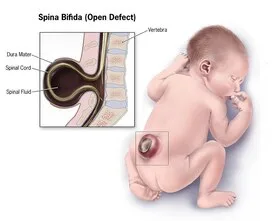
Spina Bifida
Holoprosencephaly is a condition where the forebrain of the embryo fails to split into bilateral cerebral hemispheres, resulting in insufficient separation of the cerebral hemispheres.
Clinical symptoms: Facial and neurological abnormalities.
Clinical symptoms: Facial and neurological abnormalities.

Holoprosencephaly
Arnold-Chiari Malformation is a condition where the cerebellum and medulla are displaced via the foramen magnum due to a tiny posterior fossa.
Symptoms and signs: Hydrocephalus is closely linked to thoracolumbar meningomyelocele and syringomyelia.
Symptoms and signs: Hydrocephalus is closely linked to thoracolumbar meningomyelocele and syringomyelia.
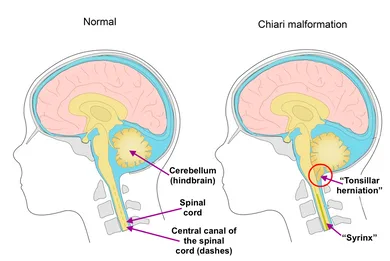
Arnold-Chiari Malformation is a condition where the cerebellum and medulla are displaced via the foramen magnum due to a tiny posterior fossa.
Symptoms and signs: Hydrocephalus is closely linked to thoracolumbar meningomyelocele and syringomyelia.
Symptoms and signs: Hydrocephalus is closely linked to thoracolumbar meningomyelocele and syringomyelia.
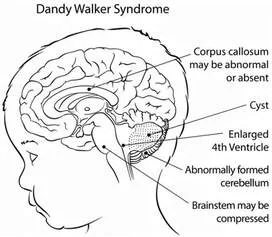
Dandy-Walker Malformation is a condition where there is a big space in the back of the brain with the cerebellar vermis replaced by a massive cyst. It is also linked to abnormalities in the brainstem nuclei.
Symptoms: Seizures and malfunctioning of the cerebellum.
0 Comments
