- Published on
Pathology - Emphysema (Variants of Chronic obstructive Pulmonary Disease)
Pathophysiology
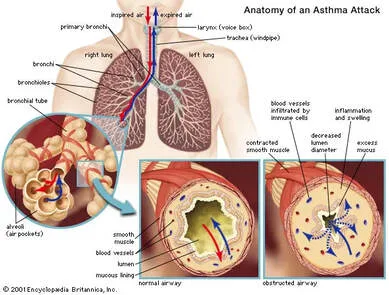
A collection of obstructive lung illnesses collectively referred to as COPD frequently co-occur in individuals with comparable epidemiologic traits. The majority of older white guys with a long history of cigarette smoking are affected by COPD. Protease inhibitor deficiency is considered to be the fundamental cause of the ongoing damaging process that leads to emphysematous COPD. Progressive tissue deterioration is the outcome of this deficit, especially in the alveoli and elastic connective tissue of terminal respiratory units. As a result, the lung tissue has more compliance and less elastic recoil. Loss of recoil causes the small airways to prematurely collapse during expiration and lacks support at the alveolar level. Due to the fact that prolonged expiration produces increased pressure in the small airways, which helps to maintain them open, patients frequently exhibit "pursed-lip" breathing. The ribs rebound outward due to the pathologic increase in lung compliance, giving the appearance of a barrel-chested person and causing gas entrapment in the distal airways. Pneumothorax is less frequent when there is no tracheal deviation or asymmetry in the breathing excursion, which is typical with COPD. Microarchitectural disturbance at the alveolar/terminal airway level affects gas exchange. Reduced alveolar ventilation and a mismatch between ventilation and perfusion lead to hypercarbia and hypoxemia.
Pathophysiology
A collection of obstructive lung illnesses collectively referred to as COPD frequently co-occur in individuals with comparable epidemiologic traits. The majority of older white guys with a long history of cigarette smoking are affected by COPD. Protease inhibitor deficiency is considered to be the fundamental cause of the ongoing damaging process that leads to emphysematous COPD. Progressive tissue deterioration is the outcome of this deficit, especially in the alveoli and elastic connective tissue of terminal respiratory units. As a result, the lung tissue has more compliance and less elastic recoil. Loss of recoil causes the small airways to prematurely collapse during expiration and lacks support at the alveolar level. Due to the fact that prolonged expiration produces increased pressure in the small airways, which helps to maintain them open, patients frequently exhibit "pursed-lip" breathing. The ribs rebound outward due to the pathologic increase in lung compliance, giving the appearance of a barrel-chested person and causing gas entrapment in the distal airways. Pneumothorax is less frequent when there is no tracheal deviation or asymmetry in the breathing excursion, which is typical with COPD. Microarchitectural disturbance at the alveolar/terminal airway level affects gas exchange. Reduced alveolar ventilation and a mismatch between ventilation and perfusion lead to hypercarbia and hypoxemia.
0 Comments
