- Published on
Pathology - Fibrocystic Breast Disease
Resulting from a hormonal imbalance characterized by elevated estrogens and/or reduced progesterones.
The highest occurrence is often observed between the ages of 25 and 50.
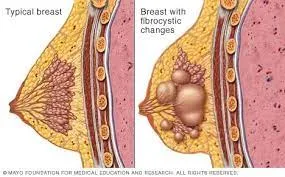
Multiple histological variations: (1) Cystic lesions: numerous fluid-filled cysts are observed as blue (referred to as blue-dome cysts). The cysts are bordered by polygonal cells with eosinophilic granular cytoplasm resembling apocrine epithelium (known as apocrine metaplasia). Papillary projections of cystic epithelium may also be present.
Epithelial hyperplasia of the breast duct refers to a rise in the number of epithelial layers in the terminal duct lobules, leading to uneven lumens. Stromal fibrosis involves hyperplasia and fibrosis of the breast stroma.
Sclerosing adenosis is characterized by an elevated quantity of acini and fibrosis in the stromal tissue.
Clinical Symptoms and Signs
Manifests as diffuse breast pain, most severe during the premenstrual phase, with many palpable lesions that are often felt on both sides. There are no changes in the skin or nipple, and the masses tend to rapidly alter in size.
Perform biopsy to rule out malignancy. Once the disease is established, address symptoms by controlling pain with NSAIDs, oral contraceptives, and a supportive brassiere.
Fibrocystic disease is the predominant breast illness. Cystic fibrosis and stromal fibrosis do not pose a higher risk for cancer, although epithelial hyperplasia and sclerosing adenosis do have a slightly elevated risk.
Resulting from a hormonal imbalance characterized by elevated estrogens and/or reduced progesterones.
The highest occurrence is often observed between the ages of 25 and 50.
Multiple histological variations: (1) Cystic lesions: numerous fluid-filled cysts are observed as blue (referred to as blue-dome cysts). The cysts are bordered by polygonal cells with eosinophilic granular cytoplasm resembling apocrine epithelium (known as apocrine metaplasia). Papillary projections of cystic epithelium may also be present.
Epithelial hyperplasia of the breast duct refers to a rise in the number of epithelial layers in the terminal duct lobules, leading to uneven lumens. Stromal fibrosis involves hyperplasia and fibrosis of the breast stroma.
Sclerosing adenosis is characterized by an elevated quantity of acini and fibrosis in the stromal tissue.
Clinical Symptoms and Signs
Manifests as diffuse breast pain, most severe during the premenstrual phase, with many palpable lesions that are often felt on both sides. There are no changes in the skin or nipple, and the masses tend to rapidly alter in size.
Perform biopsy to rule out malignancy. Once the disease is established, address symptoms by controlling pain with NSAIDs, oral contraceptives, and a supportive brassiere.
Fibrocystic disease is the predominant breast illness. Cystic fibrosis and stromal fibrosis do not pose a higher risk for cancer, although epithelial hyperplasia and sclerosing adenosis do have a slightly elevated risk.
0 Comments
