- Published on
Pathology - Giant Cell Tumor
harmless tumor originating from monocytes.
Typically impacts women in the age range of 20 to 40.
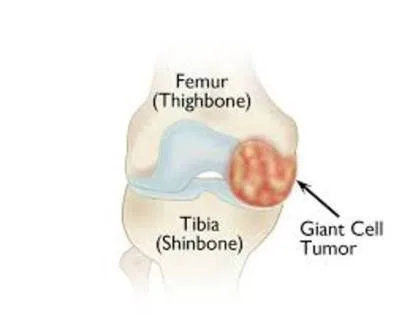
Gross: Typically develops from lengthy bone epiphyses, particularly at the knee (proximal tibia, distal femur); big, reddish-brown in color; frequently exhibits bleeding, necrosis, and cystic degeneration.
Microscopic: Spindle-shaped large cells of the osteoclast type, with up to 100 nuclei; fibrous stroma; uniform oval mononuclear cells exhibiting multiple mitoses.
Clinical Signs and Symptoms
fractures; joint pain and other signs of arthritis.
Rarely, metastases to the lung or lymph nodes are among the complications.
Visualization: appearance of a soap bubble or two bubbles on a radiograph.
Treatment includes radiation and chemotherapy if there are lung metastases in addition to surgical excision.
Though it recurs 40%–60% of the time after therapy, it is still aggressive and very rarely develops malignant.
Most often found in the hands and feet, enchondroma is a benign cartilaginous tumor that originates from the intramedullary bone. Enchondromas can be painful and result in a fracture, but they are typically asymptomatic and discovered by accident on radiographs (notice the distinctive O-ring sign on x-rays).
harmless tumor originating from monocytes.
Typically impacts women in the age range of 20 to 40.
Gross: Typically develops from lengthy bone epiphyses, particularly at the knee (proximal tibia, distal femur); big, reddish-brown in color; frequently exhibits bleeding, necrosis, and cystic degeneration.
Microscopic: Spindle-shaped large cells of the osteoclast type, with up to 100 nuclei; fibrous stroma; uniform oval mononuclear cells exhibiting multiple mitoses.
Clinical Signs and Symptoms
fractures; joint pain and other signs of arthritis.
Rarely, metastases to the lung or lymph nodes are among the complications.
Visualization: appearance of a soap bubble or two bubbles on a radiograph.
Treatment includes radiation and chemotherapy if there are lung metastases in addition to surgical excision.
Though it recurs 40%–60% of the time after therapy, it is still aggressive and very rarely develops malignant.
Most often found in the hands and feet, enchondroma is a benign cartilaginous tumor that originates from the intramedullary bone. Enchondromas can be painful and result in a fracture, but they are typically asymptomatic and discovered by accident on radiographs (notice the distinctive O-ring sign on x-rays).
0 Comments
