- Published on
Pathology - Graves Disease
Resulting from the production of thyroid-stimulating immunoglobulin and thyroid growth immunoglobulin.
Prevalent in women between the ages of 20 and 40, as well as in individuals who test positive for HLA-DR3 and HLA-B8.
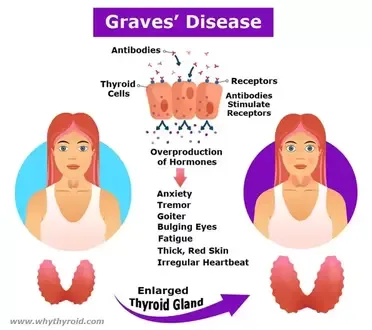
Thyroid-stimulating immunoglobulin binds to TSH receptors on thyroid follicles, leading to the stimulation of thyroid hormone synthesis. Thyroid growth immunoglobulin also induces glandular hyperplasia and hypertrophy.
Study of diseases
Enlargement of the thyroid gland in a symmetrical manner.
Microscopic findings include hypercellularity with tiny, closely packed follicles containing minimal colloid. The interstitium may show infiltration of lymphocytes.
Clinical Symptoms
Symptoms of hyperthyroidism include exophthalmos (protrusion of the eyes), thicker edematous nodules on lower extremities, and a bruit around the thyroid gland.
Imaging: A radioactive iodine scan will show a widespread increase in absorption.
Laboratory results: Decreased TSH; elevated free T4 and free T3 levels.
Therapy
Treatment options include radioactive iodine, antithyroid medications such as propylthiouracil to limit thyroid hormone synthesis, thyroidectomy, and the use of beta-blockers like propranolol to manage tachycardia.
Resulting from the production of thyroid-stimulating immunoglobulin and thyroid growth immunoglobulin.
Prevalent in women between the ages of 20 and 40, as well as in individuals who test positive for HLA-DR3 and HLA-B8.
Thyroid-stimulating immunoglobulin binds to TSH receptors on thyroid follicles, leading to the stimulation of thyroid hormone synthesis. Thyroid growth immunoglobulin also induces glandular hyperplasia and hypertrophy.
Study of diseases
Enlargement of the thyroid gland in a symmetrical manner.
Microscopic findings include hypercellularity with tiny, closely packed follicles containing minimal colloid. The interstitium may show infiltration of lymphocytes.
Clinical Symptoms
Symptoms of hyperthyroidism include exophthalmos (protrusion of the eyes), thicker edematous nodules on lower extremities, and a bruit around the thyroid gland.
Imaging: A radioactive iodine scan will show a widespread increase in absorption.
Laboratory results: Decreased TSH; elevated free T4 and free T3 levels.
Therapy
Treatment options include radioactive iodine, antithyroid medications such as propylthiouracil to limit thyroid hormone synthesis, thyroidectomy, and the use of beta-blockers like propranolol to manage tachycardia.
0 Comments
