- Published on
Pathology -Graves'Disease
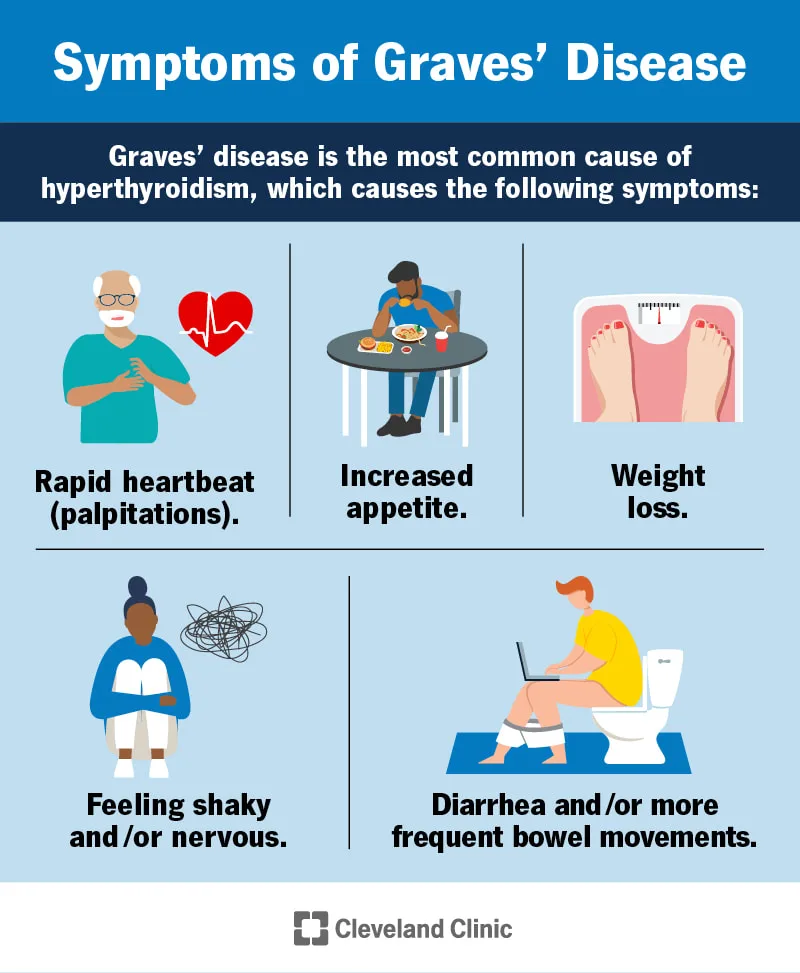
Increased metabolic rate and extensive disturbance brought on by high thyroid hormone levels frequently result in heat sensitivity and weight loss. The betaadrenergic system's overactivity causes hypertension, arrhythmias, and tachycardia, among other cardiovascular consequences. The most frequent cause of hyperthyroidism, which arises from the creation of TSI, is Graves' disease, which this patient has.
The overproduction of thyroid hormones is caused by these autoantibodies, which function as TSH receptor agonists. Additionally, the gland is growing and there is more vascularization (the bruit over the gland is indicative of this). Excess thyroid hormones have a negative feedback loop that lowers TSH levels.
A third of patients develop Graves' ophthalmopathy as a result of TSI and periorbital tissue cross-reactivity. Thyroid toxic adenomas and iodine-containing drugs like amiodarone, an anti-arrhythmic, are two more causes of hyperthyroidism.
It is uncommon to have secondary hyperthyroidism brought on by a tumor that secretes TSH. Thiourea medications are used to treat Graves' disease because they block the enzyme thyroid peroxidase, which lowers the production of thyroid hormones. It can also be necessary to have surgery or use radioactive iodine for gland ablation.
Increased metabolic rate and extensive disturbance brought on by high thyroid hormone levels frequently result in heat sensitivity and weight loss. The betaadrenergic system's overactivity causes hypertension, arrhythmias, and tachycardia, among other cardiovascular consequences. The most frequent cause of hyperthyroidism, which arises from the creation of TSI, is Graves' disease, which this patient has.
The overproduction of thyroid hormones is caused by these autoantibodies, which function as TSH receptor agonists. Additionally, the gland is growing and there is more vascularization (the bruit over the gland is indicative of this). Excess thyroid hormones have a negative feedback loop that lowers TSH levels.
A third of patients develop Graves' ophthalmopathy as a result of TSI and periorbital tissue cross-reactivity. Thyroid toxic adenomas and iodine-containing drugs like amiodarone, an anti-arrhythmic, are two more causes of hyperthyroidism.
It is uncommon to have secondary hyperthyroidism brought on by a tumor that secretes TSH. Thiourea medications are used to treat Graves' disease because they block the enzyme thyroid peroxidase, which lowers the production of thyroid hormones. It can also be necessary to have surgery or use radioactive iodine for gland ablation.
0 Comments
