- Published on
Pathology - Hereditary Hemochromatosis
Pathophysiology
Patients with inherited hemochromatosis (HH) have iron excess symptoms. Red blood cells (RBCs) contain the majority of the body's iron, which is used in hemoglobin formation. A restricted quantity of iron linked to ferritin is stored in liver cells. Transferrin is a protein that is linked to serum iron.
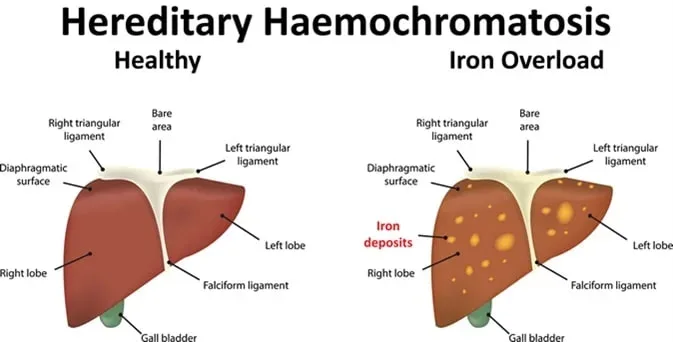
As there are no systems in place to eliminate excess iron, maintaining iron homeostasis in the duodenum necessitates controlling dietary absorption. When the liver's iron reserves are depleted, it releases the hormone hepcidin, which tells the duodenum to stop absorbing iron. It is believed that the HFE gene, which is a component of the hepatic ironsensing mechanism, is mutated in almost 90% of instances of HH. The HFE mutation leads to an increase of dietary iron absorption and a decrease in hepcidin secretion. End-organ damage from iron deposition often starts in the liver but can also affect other organs. Pancreatic islet damage is a common cause of diabetes mellitus; joint involvement and skin coloring (commonly known as "bronzing") are possible side effects. In Caucasian populations, there is a 10% to 15% carrier frequency for HH, an autosomal recessive condition. Expression of phenotypic variability is great. The majority of people are diagnosed without symptoms after being found through test screening.
Testing for genetics validates the diagnosis.
Pathophysiology
Patients with inherited hemochromatosis (HH) have iron excess symptoms. Red blood cells (RBCs) contain the majority of the body's iron, which is used in hemoglobin formation. A restricted quantity of iron linked to ferritin is stored in liver cells. Transferrin is a protein that is linked to serum iron.
As there are no systems in place to eliminate excess iron, maintaining iron homeostasis in the duodenum necessitates controlling dietary absorption. When the liver's iron reserves are depleted, it releases the hormone hepcidin, which tells the duodenum to stop absorbing iron. It is believed that the HFE gene, which is a component of the hepatic ironsensing mechanism, is mutated in almost 90% of instances of HH. The HFE mutation leads to an increase of dietary iron absorption and a decrease in hepcidin secretion. End-organ damage from iron deposition often starts in the liver but can also affect other organs. Pancreatic islet damage is a common cause of diabetes mellitus; joint involvement and skin coloring (commonly known as "bronzing") are possible side effects. In Caucasian populations, there is a 10% to 15% carrier frequency for HH, an autosomal recessive condition. Expression of phenotypic variability is great. The majority of people are diagnosed without symptoms after being found through test screening.
Testing for genetics validates the diagnosis.
0 Comments
