- Published on
Pathology - Huntington Disease
Huntington's disease is an autosomal dominant disorder caused by an excessive number of CAG repeats in the Huntington disease gene located on chromosome 4.
Typically appears between the ages of 30 and 50.
Study of diseases
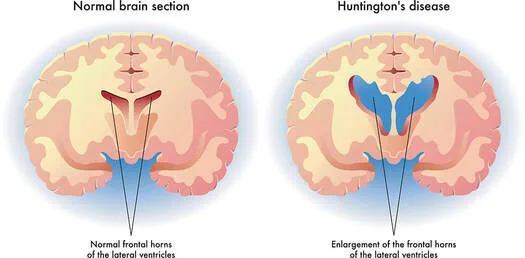
Findings: Degeneration of caudate nucleus and putamen, possible atrophy of globus pallidus and frontal lobe, and enlargement of lateral and third ventricles.
Microscopic findings include the loss of GABAergic neurons in the striatum and the presence of fibrillary gliosis.
Clinical Symptoms
A progressive disorder characterized by chorea (involuntary jerky movements), cognitive decline, and mood disorders.
Ultimately advances to profound dementia.
Treatment aimed at alleviating symptoms of dyskinesia and mood disorders.
Typically results in death after 15-20 years of being diagnosed.
Huntington disease, fragile X syndrome, and myotonic dystrophy exhibit anticipation, where the number of repeats grows in each generation, leading to progressively severe disease symptoms.
Huntington's disease is an autosomal dominant disorder caused by an excessive number of CAG repeats in the Huntington disease gene located on chromosome 4.
Typically appears between the ages of 30 and 50.
Study of diseases
Findings: Degeneration of caudate nucleus and putamen, possible atrophy of globus pallidus and frontal lobe, and enlargement of lateral and third ventricles.
Microscopic findings include the loss of GABAergic neurons in the striatum and the presence of fibrillary gliosis.
Clinical Symptoms
A progressive disorder characterized by chorea (involuntary jerky movements), cognitive decline, and mood disorders.
Ultimately advances to profound dementia.
Treatment aimed at alleviating symptoms of dyskinesia and mood disorders.
Typically results in death after 15-20 years of being diagnosed.
Huntington disease, fragile X syndrome, and myotonic dystrophy exhibit anticipation, where the number of repeats grows in each generation, leading to progressively severe disease symptoms.
0 Comments
