- Published on
Pathology - Huntington's Disease
Pathophysiology
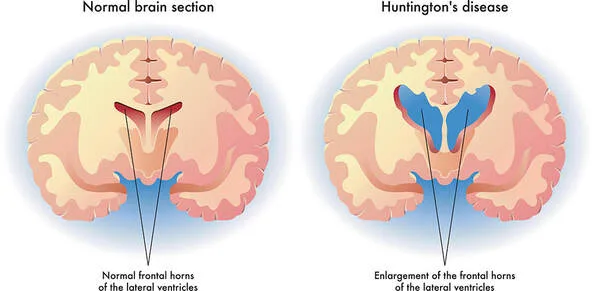
Chorea is an involuntary activity that resembles dancing that is brought on by the caudate nucleus's neuronal atrophy and loss.
Language, memory, and voluntary movement are all regulated by the caudate nucleus. The trinucleotide expansion of CAG repeats, which multiply with successive generations, is the inherited etiology of this disease. This occurrence illustrates the genetic concept of anticipation, which states that an earlier age of onset and a more severe disease are caused by an increased number of CAG repeats. The huntingtin protein, which is involved in a number of cellular processes including gene expression and trafficking, is encoded by a section of chromosome 4 that contains the CAG repeats.
Regretfully, this condition does not currently have a cure.
Pathophysiology
Chorea is an involuntary activity that resembles dancing that is brought on by the caudate nucleus's neuronal atrophy and loss.
Language, memory, and voluntary movement are all regulated by the caudate nucleus. The trinucleotide expansion of CAG repeats, which multiply with successive generations, is the inherited etiology of this disease. This occurrence illustrates the genetic concept of anticipation, which states that an earlier age of onset and a more severe disease are caused by an increased number of CAG repeats. The huntingtin protein, which is involved in a number of cellular processes including gene expression and trafficking, is encoded by a section of chromosome 4 that contains the CAG repeats.
Regretfully, this condition does not currently have a cure.
0 Comments
