- Published on
Pathology - Hypersensitivity Reactions
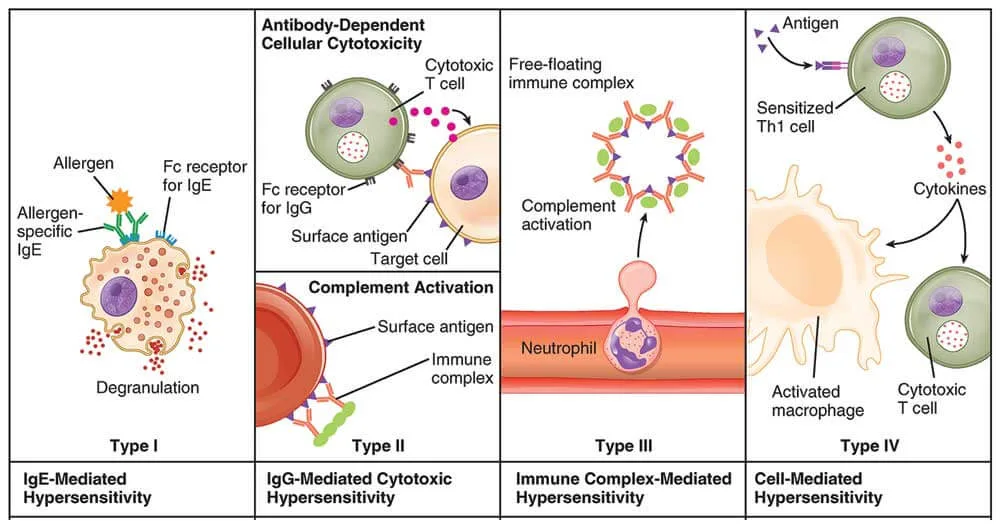
Type I: Immediate hypersensitivity mediated by IgE.
Type II: Cytotoxic hypersensitivity caused by antibodies.
Type III: Hypersensitivity mediated by immune complex.
Type IV: Delayed hypersensitivity mediated by T cells.
Type I: Vasoactive amines are released when antigen cross-links cell-bound IgE on basophils and mast cells that have been pre-sensitized. This results in tissue inflammation, vascular permeability, vasodilation, and contraction of the smooth muscle in the viscera.
Type II: In response to antigens that are bound to cells, IgG or IgM antibodies react, activating the complement cascade and destroying the antigen-bound cell.
Type III: The complement cascade is triggered when an IgG or IgM antibody combines with circulating allergens and deposits in tissue.
Type IV: T cells are exposed to allergen, which binds to endogenous protein. Memory T cells trigger an inflammatory response when they are exposed to allergens again.
Type I: Allergic rhinitis, asthma, anaphylaxis, atopy, local wheal and flare.
Type II: Goodpasture syndrome, erythroblastosis fetalis, ARF, and immune hemolytic anemia.
Serum sickness (systemic illness fever, arthralgias, proteinuria, lymphadenopathy, and dermatitis); polyarteritis nodosa; SLE; RA; Arthus reaction (localized cutaneous and subcutaneous inflammatory response to injected allergen).
Type IV: Hypersensitivity pneumonitis and Allergic Contact Dermatitis.
corticosteroids, antihistamines, and disease-specific medications.
Type I: Immediate hypersensitivity mediated by IgE.
Type II: Cytotoxic hypersensitivity caused by antibodies.
Type III: Hypersensitivity mediated by immune complex.
Type IV: Delayed hypersensitivity mediated by T cells.
Type I: Vasoactive amines are released when antigen cross-links cell-bound IgE on basophils and mast cells that have been pre-sensitized. This results in tissue inflammation, vascular permeability, vasodilation, and contraction of the smooth muscle in the viscera.
Type II: In response to antigens that are bound to cells, IgG or IgM antibodies react, activating the complement cascade and destroying the antigen-bound cell.
Type III: The complement cascade is triggered when an IgG or IgM antibody combines with circulating allergens and deposits in tissue.
Type IV: T cells are exposed to allergen, which binds to endogenous protein. Memory T cells trigger an inflammatory response when they are exposed to allergens again.
Type I: Allergic rhinitis, asthma, anaphylaxis, atopy, local wheal and flare.
Type II: Goodpasture syndrome, erythroblastosis fetalis, ARF, and immune hemolytic anemia.
Serum sickness (systemic illness fever, arthralgias, proteinuria, lymphadenopathy, and dermatitis); polyarteritis nodosa; SLE; RA; Arthus reaction (localized cutaneous and subcutaneous inflammatory response to injected allergen).
Type IV: Hypersensitivity pneumonitis and Allergic Contact Dermatitis.
corticosteroids, antihistamines, and disease-specific medications.
0 Comments
