- Published on
Pathology - IgA Nephropathy
Pathophysiology
Renal failure and an intraglomerular inflammatory process are the hallmarks of the nephritic syndrome. Hematuria and variable proteinuria are usually seen. Hematuria is the cause of dark brown urine. Red cell casts and dysmorphic RBCs both suggest that hematuria has a glomerular origin. Red blood cells that have crossed the glomerular basement membrane exhibit dysmorphic changes. Red blood cells and the Tamm-Horsfall protein in the tubule combine to generate RBC casts. There are numerous causes of nephritic syndrome; however, in general, the inflammatory process can be brought on by antibodies attaching to glomerulus structures (such as the basement membrane), by circulating immune complexes that accumulate in the glomerulus, or by deposited antigens that precipitate inflammation. One instance of an immune complex forming in the bloodstream is IgA nephropathy, which is assumed to be caused by faulty IgA molecules that self-aggregate. Episodes differ in timing from traditional post-streptococcal glomerulonephritis, in which hematuria appears one to two weeks after infection, and frequently co-occur with upper respiratory tract infections. The traditional tetrad of symptoms—rash, joint pain, abdominal discomfort, and hematuria—is experienced by certain IgA nephropathy patients. Henoch-Schönlein purpura, a more widespread form of IgAdominant vasculitis, is the ailment in question.
Pathophysiology
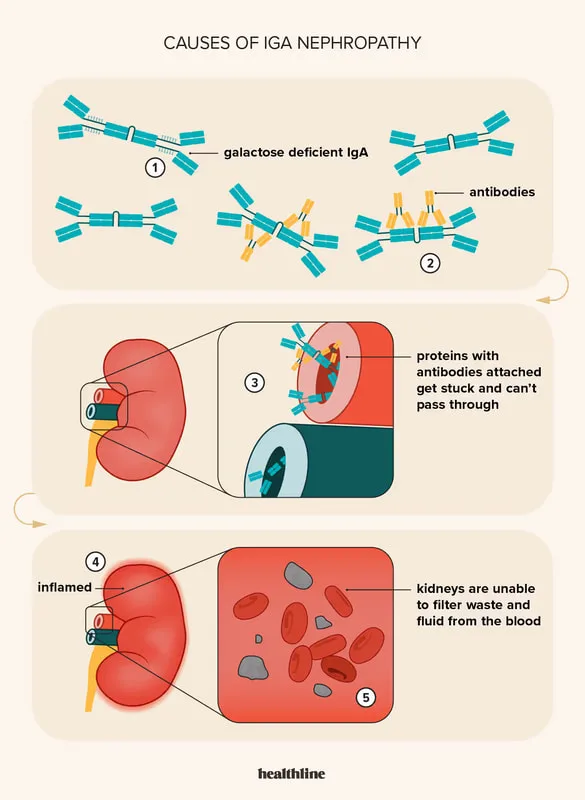
Renal failure and an intraglomerular inflammatory process are the hallmarks of the nephritic syndrome. Hematuria and variable proteinuria are usually seen. Hematuria is the cause of dark brown urine. Red cell casts and dysmorphic RBCs both suggest that hematuria has a glomerular origin. Red blood cells that have crossed the glomerular basement membrane exhibit dysmorphic changes. Red blood cells and the Tamm-Horsfall protein in the tubule combine to generate RBC casts. There are numerous causes of nephritic syndrome; however, in general, the inflammatory process can be brought on by antibodies attaching to glomerulus structures (such as the basement membrane), by circulating immune complexes that accumulate in the glomerulus, or by deposited antigens that precipitate inflammation. One instance of an immune complex forming in the bloodstream is IgA nephropathy, which is assumed to be caused by faulty IgA molecules that self-aggregate. Episodes differ in timing from traditional post-streptococcal glomerulonephritis, in which hematuria appears one to two weeks after infection, and frequently co-occur with upper respiratory tract infections. The traditional tetrad of symptoms—rash, joint pain, abdominal discomfort, and hematuria—is experienced by certain IgA nephropathy patients. Henoch-Schönlein purpura, a more widespread form of IgAdominant vasculitis, is the ailment in question.
0 Comments
