- Published on
Pathology - Lupus Nephropathy
Renal involvement in systemic lupus erythematosus.
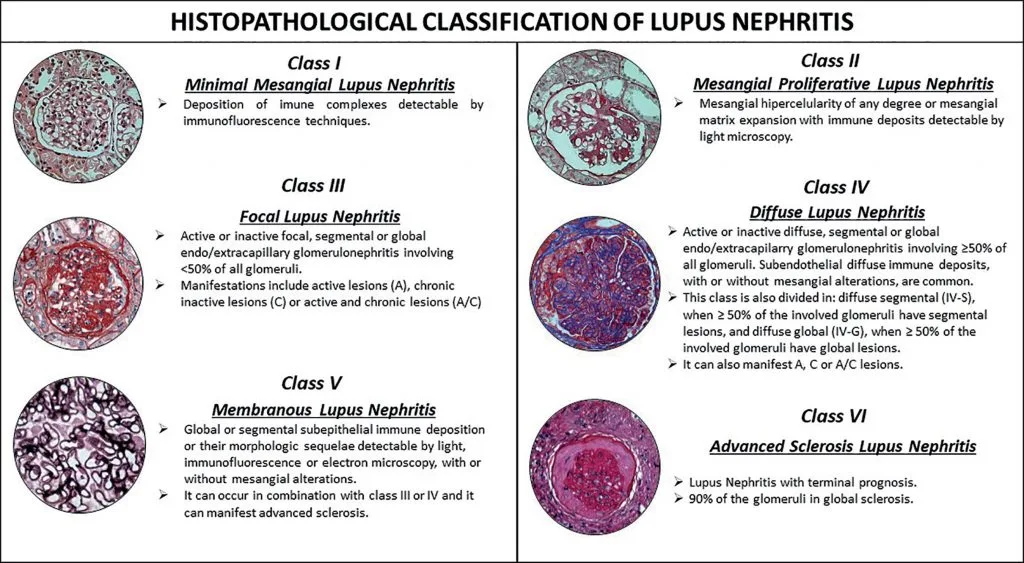
There are five different kidney histologic patterns. 1. Type I: normal; 2. Type II (mesangial form): focal and segmental glomerular involvement with increased mesangial matrix; 3. Type III (focal proliferative form): affects less than half of glomeruli, causing extensive damage to individual glomeruli; 4. Type IV (diffuse proliferative form): the most severe form involving all glomeruli with significant inflammation, mesangial proliferation, and scarring. Light microscopy shows wire-loop irregularity due to immune complex deposition and significant thickening of the glomerular basement membrane. Examining endothelial cell growth with electron microscopy. Immunofluorescence shows significant accumulation of immunological complexes in the subendothelial layer.
(5) Type V (membranous form) resembles membranous glomerulonephritis.
Clinical Symptoms
Type I: No observable clinical symptoms.
Types II and III present with mild to moderate levels of proteinuria and hematuria.
Type IV involves a combination of symptoms from both nephrotic and nephritic illnesses.
Nephrotic syndrome is classified as Type V.
Therapies
Types I and II: No intervention required.
Types III, IV, and V involve immunosuppressive treatment such as corticosteroids, cyclophosphamide, and/or azathioprine. Severe cases may require transplantation or dialysis.
The degree of renal lesions frequently dictates the overall outcome of patients with systemic lupus erythematosus (SLE).
Renal involvement in systemic lupus erythematosus.
There are five different kidney histologic patterns. 1. Type I: normal; 2. Type II (mesangial form): focal and segmental glomerular involvement with increased mesangial matrix; 3. Type III (focal proliferative form): affects less than half of glomeruli, causing extensive damage to individual glomeruli; 4. Type IV (diffuse proliferative form): the most severe form involving all glomeruli with significant inflammation, mesangial proliferation, and scarring. Light microscopy shows wire-loop irregularity due to immune complex deposition and significant thickening of the glomerular basement membrane. Examining endothelial cell growth with electron microscopy. Immunofluorescence shows significant accumulation of immunological complexes in the subendothelial layer.
(5) Type V (membranous form) resembles membranous glomerulonephritis.
Clinical Symptoms
Type I: No observable clinical symptoms.
Types II and III present with mild to moderate levels of proteinuria and hematuria.
Type IV involves a combination of symptoms from both nephrotic and nephritic illnesses.
Nephrotic syndrome is classified as Type V.
Therapies
Types I and II: No intervention required.
Types III, IV, and V involve immunosuppressive treatment such as corticosteroids, cyclophosphamide, and/or azathioprine. Severe cases may require transplantation or dialysis.
The degree of renal lesions frequently dictates the overall outcome of patients with systemic lupus erythematosus (SLE).
0 Comments
