- Published on
Pathology - Membranoproliferaitve Glomerulonephritis
The patient is suffering from MPGN, or membrane proliferative glomerulonephritis.
Although there are differences in the severity of presentation, hypertension and a certain level of reduced renal function are frequently present. In this instance, nephrotic syndrome—which causes protein loss and edema—combines with nephritis, resulting in blood in the urine of glomerular origin. Uninterrupted complement cascade activation within the glomerulus is the source of inflammation.
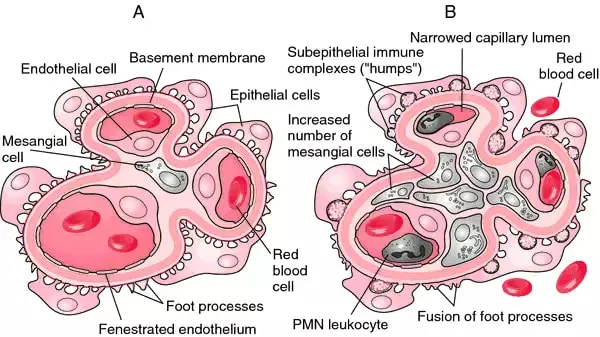
The immune complex deposition or anomalies of the complement's inhibitory regulatory components can start the cascade. Therefore, the condition's hallmark is serum complement depletion. Crescent formation is a sign of more advanced illness and results from cellular growth in Bowman's space, which compresses the functioning filtration membrane. MPGN can be secondary, frequently associated with a history of hepatitis C infection, or primary (idiopathic), for which the origin is unknown. Based on the location of dense deposits on electron microscopy, three types of MPGN are identified: Type I, which is subendothelial and mesangial as in this instance; Type II, which is intramembranous within the glomerular basement membrane; and Type III, which is subendothelial, mesangial, and subepithelial. A distinct complement activation profile is linked to each variation.
The patient is suffering from MPGN, or membrane proliferative glomerulonephritis.
Although there are differences in the severity of presentation, hypertension and a certain level of reduced renal function are frequently present. In this instance, nephrotic syndrome—which causes protein loss and edema—combines with nephritis, resulting in blood in the urine of glomerular origin. Uninterrupted complement cascade activation within the glomerulus is the source of inflammation.
The immune complex deposition or anomalies of the complement's inhibitory regulatory components can start the cascade. Therefore, the condition's hallmark is serum complement depletion. Crescent formation is a sign of more advanced illness and results from cellular growth in Bowman's space, which compresses the functioning filtration membrane. MPGN can be secondary, frequently associated with a history of hepatitis C infection, or primary (idiopathic), for which the origin is unknown. Based on the location of dense deposits on electron microscopy, three types of MPGN are identified: Type I, which is subendothelial and mesangial as in this instance; Type II, which is intramembranous within the glomerular basement membrane; and Type III, which is subendothelial, mesangial, and subepithelial. A distinct complement activation profile is linked to each variation.
0 Comments
