- Published on
Pathology - Obstructive Uropathy
Pathogenesis
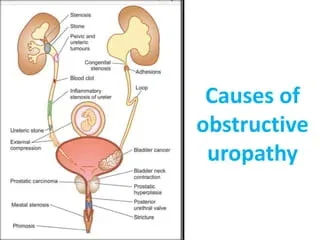
In this instance, persistent bladder outlet obstruction has been caused by urethral stricture, a frequent condition in older men (notice bladder wall thickening). A urinary tract infection has resulted from urinary stasis (notice urine culture and fever). Urine retention and elevated pressure in the urine collection system due to bladder obstruction result in hydronephrosis, which is characterized by dilatation of the renal pelvis and calyces. GFR declines as a result of decreased net ultrafiltration pressure brought on by increased back pressure in the nephron and Bowman's space. A reduction in potassium and hydrogen ion release as a result of impaired distal tubular performance leads to metabolic acidosis and hyperkalemia.
The goal of treatment is to remove the obstruction—in this case, the urinary tract infection—as soon as possible. The degree and length of blockage determine how much renal function recovers. Long-term catheter use is not preferred over definitive therapy, such as surgically removing tumors, stones, the prostate gland, etc.
Pathogenesis
In this instance, persistent bladder outlet obstruction has been caused by urethral stricture, a frequent condition in older men (notice bladder wall thickening). A urinary tract infection has resulted from urinary stasis (notice urine culture and fever). Urine retention and elevated pressure in the urine collection system due to bladder obstruction result in hydronephrosis, which is characterized by dilatation of the renal pelvis and calyces. GFR declines as a result of decreased net ultrafiltration pressure brought on by increased back pressure in the nephron and Bowman's space. A reduction in potassium and hydrogen ion release as a result of impaired distal tubular performance leads to metabolic acidosis and hyperkalemia.
The goal of treatment is to remove the obstruction—in this case, the urinary tract infection—as soon as possible. The degree and length of blockage determine how much renal function recovers. Long-term catheter use is not preferred over definitive therapy, such as surgically removing tumors, stones, the prostate gland, etc.
0 Comments
