- Published on
Pathology - Osteogenesis Imperfecta
Inherited mutations lead to a lack of type 1 collagen synthesis, affecting bone, teeth, ears, eyes, and skin. Inheritance is primarily autosomal dominant, although there are occasional instances of autosomal recessive inheritance. There are four varieties, with type II being the most severe and typically leading to neonatal mortality.
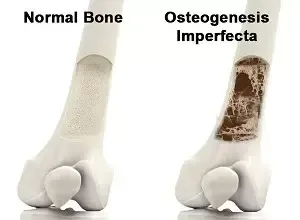
Bone shows cortical thinning with trabecular thinning resembling osteoporosis.
Multiple fractures resulting from minor trauma; blue sclerae caused by the transparency of connective tissue over choroids; hearing loss due to aberrant middle ear bones; dental abnormalities.
Therapy
Utilizing pneumatic bracing to prevent trauma.
The prognosis varies depending on the type of disease and might range from mortality in infancy to a typical lifespan.
Achondroplasia is the outcome of an autosomal dominant mutation in the fibroblast growth factor receptor 3 (FGFR3) gene on chromosome 4, leading to irregularities in cartilage calcification and restructuring. It presents clinically as dwarfism, with small limbs and a normal trunk, and is defined by narrow epiphyseal plates and short, thick bones.
Inherited mutations lead to a lack of type 1 collagen synthesis, affecting bone, teeth, ears, eyes, and skin. Inheritance is primarily autosomal dominant, although there are occasional instances of autosomal recessive inheritance. There are four varieties, with type II being the most severe and typically leading to neonatal mortality.
Bone shows cortical thinning with trabecular thinning resembling osteoporosis.
Multiple fractures resulting from minor trauma; blue sclerae caused by the transparency of connective tissue over choroids; hearing loss due to aberrant middle ear bones; dental abnormalities.
Therapy
Utilizing pneumatic bracing to prevent trauma.
The prognosis varies depending on the type of disease and might range from mortality in infancy to a typical lifespan.
Achondroplasia is the outcome of an autosomal dominant mutation in the fibroblast growth factor receptor 3 (FGFR3) gene on chromosome 4, leading to irregularities in cartilage calcification and restructuring. It presents clinically as dwarfism, with small limbs and a normal trunk, and is defined by narrow epiphyseal plates and short, thick bones.
0 Comments
