- Published on
Pathology - Parkinson Disease
Cause unclear.
Typically occurs in those over the age of 50.
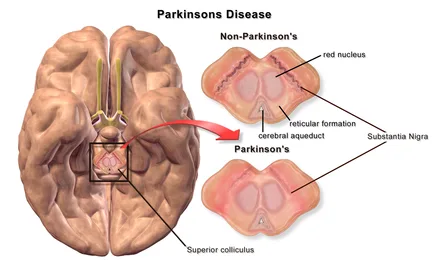
Pathology: The substantia nigra and locus ceruleus seem pale upon examination.
Microscopic examination reveals the absence of pigmented dopaminergic neurons in the substantia nigra along with gliosis. Additionally, Lewy bodies, which are eosinophilic intracytoplasmic inclusion bodies, are present in the neurons of the substantia nigra.
Pathophysiology: Decreased dopaminergic input to the striatum causes reduced activation of the basal ganglia motor circuit, resulting in bradykinesia.
Clinical Symptoms
Cluster of symptoms including pill-rolling tremor, bradykinesia, shuffling gait, rigidity with cogwheeling of extremities upon passive motion, postural instability, and expressionless facies, collectively referred to as parkinsonism.
10%-15% of individuals with Parkinson's disease experience dementia.
Treatment involves pharmacologic therapy using medications such as amantadine, anticholinergics, levodopa, dopamine agonists, and MAO-B inhibitors.
Additional factors leading to parkinsonism are recurrent head injuries (common in boxers), some medications (such as MPTP), parkinsonism following encephalitis (seen after the influenza outbreak in the early 1900s), and Shy-Drager syndrome (parkinsonism accompanied by orthostatic hypotension and autonomic dysfunction).
Cause unclear.
Typically occurs in those over the age of 50.
Pathology: The substantia nigra and locus ceruleus seem pale upon examination.
Microscopic examination reveals the absence of pigmented dopaminergic neurons in the substantia nigra along with gliosis. Additionally, Lewy bodies, which are eosinophilic intracytoplasmic inclusion bodies, are present in the neurons of the substantia nigra.
Pathophysiology: Decreased dopaminergic input to the striatum causes reduced activation of the basal ganglia motor circuit, resulting in bradykinesia.
Clinical Symptoms
Cluster of symptoms including pill-rolling tremor, bradykinesia, shuffling gait, rigidity with cogwheeling of extremities upon passive motion, postural instability, and expressionless facies, collectively referred to as parkinsonism.
10%-15% of individuals with Parkinson's disease experience dementia.
Treatment involves pharmacologic therapy using medications such as amantadine, anticholinergics, levodopa, dopamine agonists, and MAO-B inhibitors.
Additional factors leading to parkinsonism are recurrent head injuries (common in boxers), some medications (such as MPTP), parkinsonism following encephalitis (seen after the influenza outbreak in the early 1900s), and Shy-Drager syndrome (parkinsonism accompanied by orthostatic hypotension and autonomic dysfunction).
0 Comments
