- Published on
Pathology - Penile Cancer
Bowen's disease impacts men over the age of 50 who are not circumcised.
Erythroplasia of Queyrat typically occurs in individuals in their fifth decade and is considered a form of Bowen's disease.
Bowenoid papulosis primarily affects a younger demographic.
Penile Squamous Cell Carcinoma has a higher occurrence in Asia and Africa, typically affecting those aged 40-70. Risk factors include being uncircumcised, having poor hygiene, and being infected with HPV types 16, 18, 31, and 33.
Bowen's disease is characterized by the abnormal growth of epidermal cells with atypical cell divisions, although the basement membrane between the epidermis and dermis remains intact.
Erythroplasia of Queyrat and Bowenoid Papulosis are histologically similar to Bowen Disease.
Penile Squamous Cell Carcinoma originates from Bowen Disease and Erythroplasia of Queyrat. Papillary lesions resemble condyloma acuminata and form a cauliflower-like mass. Flat lesions present as thickened regions of epithelium with mucosal fissuring.
Bowen's disease presents as a single red patch on the penis or scrotum; less than 10% progress to invasive cancer and is linked to a higher chance of developing internal malignancies.
Erythroplasia of Queyrat presents as a solitary red patch on the glans penis or prepuce, with a 10% chance of progressing to aggressive cancer.
Bowenoid Papulosis is characterized by many wart-like lesions similar to condylomata acuminatum, although it does not develop into aggressive cancer.
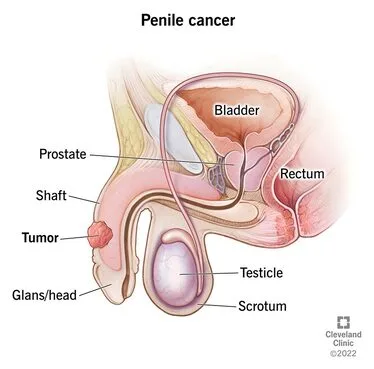
Penile Squamous Cell Carcinoma is a painless lesion that can bleed, develop secondary ulceration, and become infected.
Excision of penile squamous cell cancer.
Bowen's disease impacts men over the age of 50 who are not circumcised.
Erythroplasia of Queyrat typically occurs in individuals in their fifth decade and is considered a form of Bowen's disease.
Bowenoid papulosis primarily affects a younger demographic.
Penile Squamous Cell Carcinoma has a higher occurrence in Asia and Africa, typically affecting those aged 40-70. Risk factors include being uncircumcised, having poor hygiene, and being infected with HPV types 16, 18, 31, and 33.
Bowen's disease is characterized by the abnormal growth of epidermal cells with atypical cell divisions, although the basement membrane between the epidermis and dermis remains intact.
Erythroplasia of Queyrat and Bowenoid Papulosis are histologically similar to Bowen Disease.
Penile Squamous Cell Carcinoma originates from Bowen Disease and Erythroplasia of Queyrat. Papillary lesions resemble condyloma acuminata and form a cauliflower-like mass. Flat lesions present as thickened regions of epithelium with mucosal fissuring.
Bowen's disease presents as a single red patch on the penis or scrotum; less than 10% progress to invasive cancer and is linked to a higher chance of developing internal malignancies.
Erythroplasia of Queyrat presents as a solitary red patch on the glans penis or prepuce, with a 10% chance of progressing to aggressive cancer.
Bowenoid Papulosis is characterized by many wart-like lesions similar to condylomata acuminatum, although it does not develop into aggressive cancer.
Penile Squamous Cell Carcinoma is a painless lesion that can bleed, develop secondary ulceration, and become infected.
Excision of penile squamous cell cancer.
0 Comments
