- Published on
Pathology - Peripheral Vascular Disease
Pathophysiology
Peripheral vascular disease, another name for severe atherosclerotic disease, is present throughout her body.
Every adult has some degree of atherosclerosis, a disorder marked by localized fibrous thickenings of the artery wall connected to lipid-infiltrated plaques.
Due to their susceptibility to ulceration and rupture, atherosclerotic plaques can impede arterial flow by causing thrombi to develop. Atheroclerosis causes aberrant circulation in the kidneys, dilatation or even rupture of the aorta and other major arteries, and vascular insufficiency in the limbs. Intravascular clot development is a major cause of serious, potentially fatal heart and brain illnesses.
This process is believed to be a chronic inflammatory reaction in the artery wall, mostly brought on by an accumulation of macrophages working in tandem with LDL and insufficient HDL-produced fatty acids and cholesterol.
The ingredients build up into an atherosclerotic plaque over time.
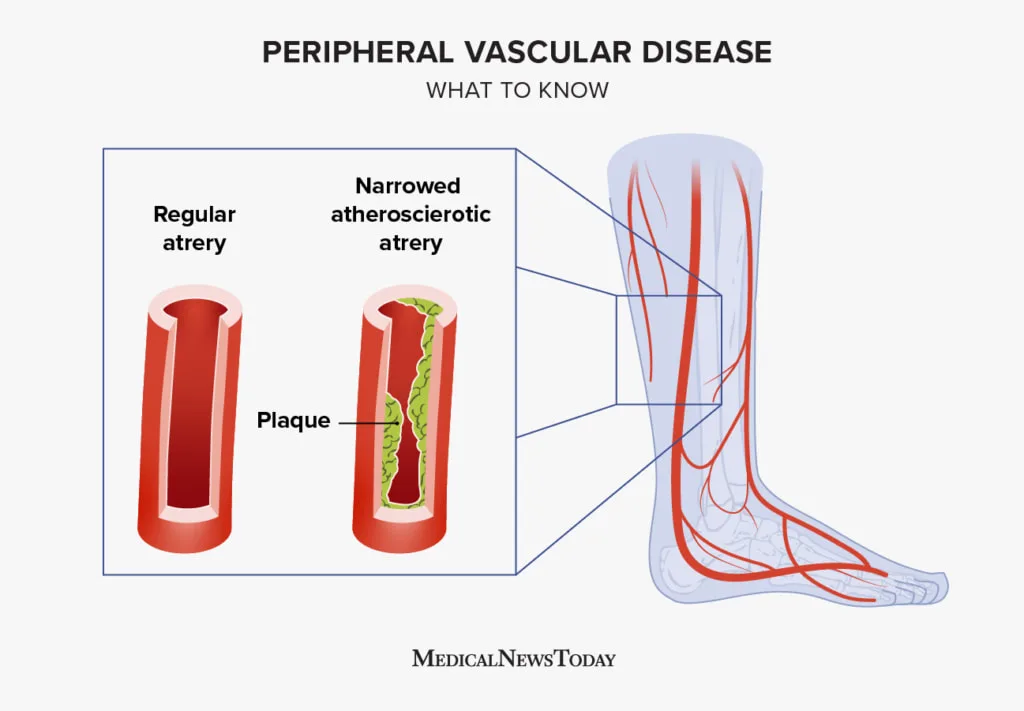
Within the body's major arteries, plaque formation results in alterations to the intima and a reduction in lumen size. Vessel bifurcations and the coronary, carotid, femoral, or iliac arteries in the lower limbs are common locations of critical constriction. Walking causes agony for this patient because of an increased oxygen demand that atherosclerotic blood arteries cannot supply.
ABI testing is a straightforward, noninvasive assessment that contrasts the artery flow in the upper and lower extremities. ABI results that are abnormal may point to the necessity for more sophisticated vessel imaging as well as support the existence of peripheral vascular disease.
Pathophysiology
Peripheral vascular disease, another name for severe atherosclerotic disease, is present throughout her body.
Every adult has some degree of atherosclerosis, a disorder marked by localized fibrous thickenings of the artery wall connected to lipid-infiltrated plaques.
Due to their susceptibility to ulceration and rupture, atherosclerotic plaques can impede arterial flow by causing thrombi to develop. Atheroclerosis causes aberrant circulation in the kidneys, dilatation or even rupture of the aorta and other major arteries, and vascular insufficiency in the limbs. Intravascular clot development is a major cause of serious, potentially fatal heart and brain illnesses.
This process is believed to be a chronic inflammatory reaction in the artery wall, mostly brought on by an accumulation of macrophages working in tandem with LDL and insufficient HDL-produced fatty acids and cholesterol.
The ingredients build up into an atherosclerotic plaque over time.
Within the body's major arteries, plaque formation results in alterations to the intima and a reduction in lumen size. Vessel bifurcations and the coronary, carotid, femoral, or iliac arteries in the lower limbs are common locations of critical constriction. Walking causes agony for this patient because of an increased oxygen demand that atherosclerotic blood arteries cannot supply.
ABI testing is a straightforward, noninvasive assessment that contrasts the artery flow in the upper and lower extremities. ABI results that are abnormal may point to the necessity for more sophisticated vessel imaging as well as support the existence of peripheral vascular disease.
0 Comments
