- Published on
Pathology - Pituitary Cachexia
Sheehan syndrome is typically caused by pituitary adenomas, ischemic necrosis of the anterior pituitary after postpartum hemorrhage, pituitary surgery, pituitary radiotherapy, or pituitary damage.
Adenoma is a defined growth made up of uniform, polygonal cells.
Sheehan syndrome is characterized by an early hemorrhagic lesion in the anterior pituitary that eventually resolves into a tiny fibrous band.
Generalized panhypopituitarism presents as hypothyroidism (low TSH), hypogonadism with infertility (low LH and FSH), hypocortisolism (low ACTH), reduced prolactin, and decreased growth hormone.
Bitemporal hemianopsia may occur if caused by adenoma, resulting from the compression of the optic chiasm.
Laboratory results: Low blood sugar; low sodium levels; reduced levels of estrogen, testosterone, and progesterone; lowered cortisol; decreased T4.
Treatment options include hormone replacement therapy and surgical excision of the adenoma.
Pituitary adenomas can lead to hyperpituitarism and may be linked to MEN type I syndrome.
Sheehan syndrome is typically caused by pituitary adenomas, ischemic necrosis of the anterior pituitary after postpartum hemorrhage, pituitary surgery, pituitary radiotherapy, or pituitary damage.
Adenoma is a defined growth made up of uniform, polygonal cells.
Sheehan syndrome is characterized by an early hemorrhagic lesion in the anterior pituitary that eventually resolves into a tiny fibrous band.
Generalized panhypopituitarism presents as hypothyroidism (low TSH), hypogonadism with infertility (low LH and FSH), hypocortisolism (low ACTH), reduced prolactin, and decreased growth hormone.
Bitemporal hemianopsia may occur if caused by adenoma, resulting from the compression of the optic chiasm.
Laboratory results: Low blood sugar; low sodium levels; reduced levels of estrogen, testosterone, and progesterone; lowered cortisol; decreased T4.
Treatment options include hormone replacement therapy and surgical excision of the adenoma.
Pituitary adenomas can lead to hyperpituitarism and may be linked to MEN type I syndrome.
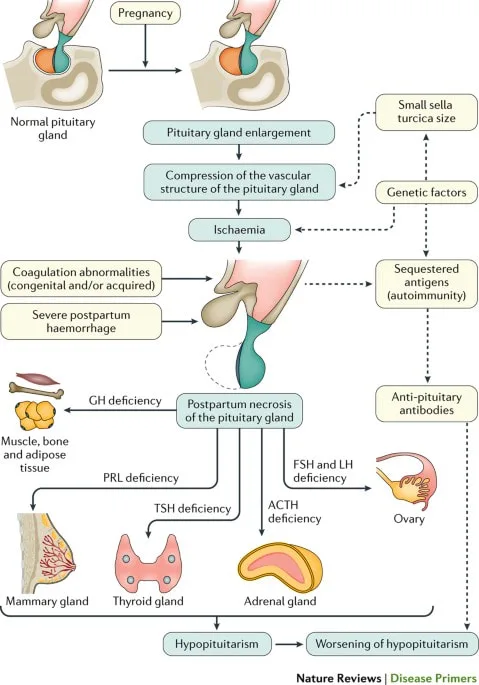
Sheehan Syndrome
0 Comments
