- Published on
Pathology- Pre Renal Azotemia
Pathophysiology
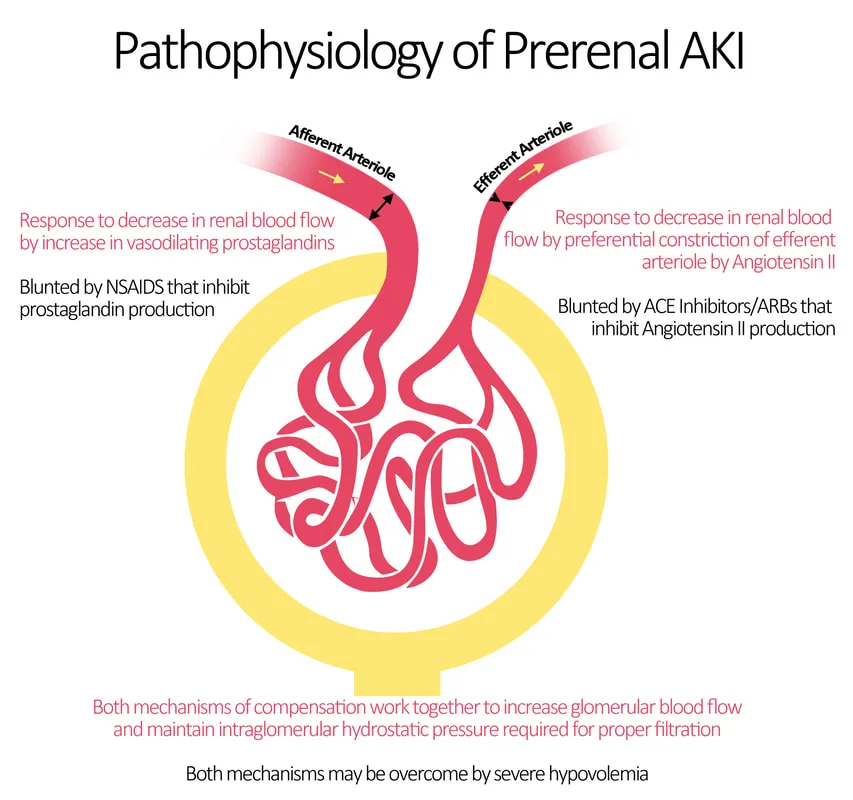
Acute kidney injury (AKI) is characterized by decreased glomerular filtration rate (GFR) and oliguria, or urine flow less than 0.5 mL/kg/h, as well as a recent doubling of serum creatinine. In this instance, decreased renal arterial perfusion is the source of renal dysfunction, which is known as pre-renal etiology of AKI. Reduced cardiac output from aortic stenosis results in decreased LV stroke volume (notice the lower pulse pressure), which lowers renal perfusion. Arterial constriction and tachycardia have been caused by baroreceptor activation. When pre-renal azotemia occurs, the BUN:creatinine ratio rises to more than 20:1, which is higher than normal.
When there is a low effective circulating volume, there is a rise in tubular urea reabsorption, which results in a high BUN. This is caused by high levels of ADH.
A pre-renal etiology is further suggested by fractional sodium excretion of less than 1%, which is indicative of avid tubular sodium reabsorption. When there is a low effective circulation volume, the renin-angiotensin-aldosterone system is active, and the renal tubules are responding appropriately to this high level of activity. In this scenario, renal function should be corrected as soon as renal perfusion is restored. The patient's dyspnea necessitates a careful assessment of his aortic stenosis in order to decide whether surgery is necessary.
Pathophysiology
Acute kidney injury (AKI) is characterized by decreased glomerular filtration rate (GFR) and oliguria, or urine flow less than 0.5 mL/kg/h, as well as a recent doubling of serum creatinine. In this instance, decreased renal arterial perfusion is the source of renal dysfunction, which is known as pre-renal etiology of AKI. Reduced cardiac output from aortic stenosis results in decreased LV stroke volume (notice the lower pulse pressure), which lowers renal perfusion. Arterial constriction and tachycardia have been caused by baroreceptor activation. When pre-renal azotemia occurs, the BUN:creatinine ratio rises to more than 20:1, which is higher than normal.
When there is a low effective circulating volume, there is a rise in tubular urea reabsorption, which results in a high BUN. This is caused by high levels of ADH.
A pre-renal etiology is further suggested by fractional sodium excretion of less than 1%, which is indicative of avid tubular sodium reabsorption. When there is a low effective circulation volume, the renin-angiotensin-aldosterone system is active, and the renal tubules are responding appropriately to this high level of activity. In this scenario, renal function should be corrected as soon as renal perfusion is restored. The patient's dyspnea necessitates a careful assessment of his aortic stenosis in order to decide whether surgery is necessary.
0 Comments
