- Published on
Pathology - Primary Adrenocortical Insufficiency (Addison Disease)
Addison's disease is a kind of primary adrenocortical insufficiency.
Possible causes consist of autoimmune adrenalitis, TB infection, bilateral adrenal bleeding after trauma, surgery, or anticoagulant medication, amyloidosis, and metastatic neoplasms in the adrenal gland.
Pathology
Gross: Adrenal gland that has decreased in size due to atrophy.
Microscopic findings include a small number of cortical cells and the presence of lymphoid infiltration, which is characteristic of autoimmune adrenalitis.
Clinical Symptoms
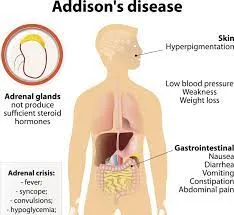
Symptoms of reduced glucocorticoids include weakness, weariness, nausea, vomiting, and skin hyperpigmentation caused by elevated MSH production, a precursor molecule of ACTH.
Symptoms of reduced mineralocorticoids include low blood pressure, low blood sugar, high levels of potassium, and low levels of sodium.
Laboratory results indicate increased ACTH levels and decreased cortisol levels.
Treatment involves replacing glucocorticoids and mineralocorticoids.
Secondary adrenocortical insufficiency can result from pituitary or hypothalamic disorders that decrease ACTH production, including persistent glucocorticoid medication, malignancy, infection, or trauma. This condition resembles primary adrenocortical insufficiency but lacks hyperpigmentation due to reduced MSH levels.
Waterhouse-Friderichsen syndrome is characterized by sudden bilateral adrenal insufficiency resulting from hemorrhagic necrosis of the adrenal glands, typically triggered by disseminated intravascular coagulation (DIC) or meningococcemia.
Addison's disease is a kind of primary adrenocortical insufficiency.
Possible causes consist of autoimmune adrenalitis, TB infection, bilateral adrenal bleeding after trauma, surgery, or anticoagulant medication, amyloidosis, and metastatic neoplasms in the adrenal gland.
Pathology
Gross: Adrenal gland that has decreased in size due to atrophy.
Microscopic findings include a small number of cortical cells and the presence of lymphoid infiltration, which is characteristic of autoimmune adrenalitis.
Clinical Symptoms
Symptoms of reduced glucocorticoids include weakness, weariness, nausea, vomiting, and skin hyperpigmentation caused by elevated MSH production, a precursor molecule of ACTH.
Symptoms of reduced mineralocorticoids include low blood pressure, low blood sugar, high levels of potassium, and low levels of sodium.
Laboratory results indicate increased ACTH levels and decreased cortisol levels.
Treatment involves replacing glucocorticoids and mineralocorticoids.
Secondary adrenocortical insufficiency can result from pituitary or hypothalamic disorders that decrease ACTH production, including persistent glucocorticoid medication, malignancy, infection, or trauma. This condition resembles primary adrenocortical insufficiency but lacks hyperpigmentation due to reduced MSH levels.
Waterhouse-Friderichsen syndrome is characterized by sudden bilateral adrenal insufficiency resulting from hemorrhagic necrosis of the adrenal glands, typically triggered by disseminated intravascular coagulation (DIC) or meningococcemia.
0 Comments
