- Published on
Pathology - Pulmonary Embolism
Pathophysiology
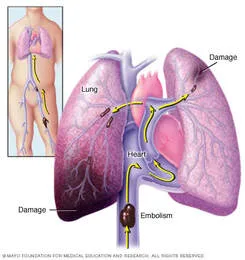
This is caused by a venous thrombus that eventually migrates to the pulmonary circulation; these thrombi typically originate from the lower extremities, as in this instance. The right side of the heart becomes obstructed and experiences resistance to flow when a thrombus lodges in a channel that is too tiny to allow it to pass. The size of pulmonary emboli varies, and the obstruction's severity and size will determine the clinical presentation. Prolonged immobilization, cancer, and the first few weeks after giving birth are risk factors. Since the obstruction raises pulmonary artery pressure, prominent pulmonic valve closure can be seen and is brought on by increased pressure across the valve. Hemoptysis, low-grade fever, sinus tachycardia, tachypnea, reduced peripheral oxygen saturation, and ECG indications of right heart strain are further common symptoms.
Pathophysiology
This is caused by a venous thrombus that eventually migrates to the pulmonary circulation; these thrombi typically originate from the lower extremities, as in this instance. The right side of the heart becomes obstructed and experiences resistance to flow when a thrombus lodges in a channel that is too tiny to allow it to pass. The size of pulmonary emboli varies, and the obstruction's severity and size will determine the clinical presentation. Prolonged immobilization, cancer, and the first few weeks after giving birth are risk factors. Since the obstruction raises pulmonary artery pressure, prominent pulmonic valve closure can be seen and is brought on by increased pressure across the valve. Hemoptysis, low-grade fever, sinus tachycardia, tachypnea, reduced peripheral oxygen saturation, and ECG indications of right heart strain are further common symptoms.
0 Comments
