- Published on
Pathology - Renal damage and nonsteroidal anti-inflammatory drugs
Pathophysiology
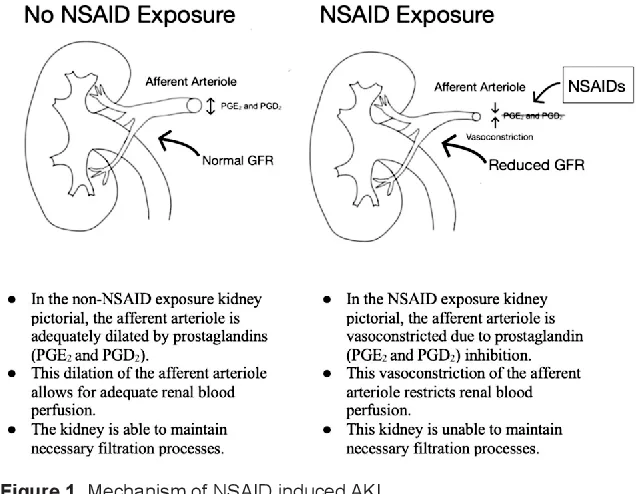
This is exceedingly uncommon in euvolemic individuals with normal renal function, but it is much more common in patients with hypertension or chronic kidney disease (CKD) and those with pre-existing risk factors such as states of decreased effective circulation volume. Angiotensin II, vasopressin, and renal sympathetic nerves all have vasoconstrictor and antinatriuretic effects; renal prostaglandins operate as local counterregulatory hormones to counteract these effects.
In euvolemia, their activity level is minimal, but when the effective circulatory volume is low, they play a crucial compensatory role in maintaining renal blood flow and glomerular filtration. In addition to taking high doses of an NSAID, which caused renal vasoconstriction and increased tubular salt retention, this patient has a history of hypertension, which puts them at risk. A pre-renal pattern with a BUN:creatinine ratio larger than 20 is caused by elevated serum creatinine and BUN. Reduced renal excretory function leads to fluid retention, which exacerbates hypertension again, and water retention, which results in hyponatremia. Inadequate excretion of hydrogen and potassium ions results in hyperkalemia and metabolic acidosis.
When combined with the absence of renal tubular cells in the urine sediment, low urine sodium excretion suggests enthusiastic tube absorption and indicates that the patient has not advanced to ATN. Imaging shows the absence of any obstructing processes. The goal of treatment is to stop taking NSAIDs; if this happens, the issue should resolve on its own.
Pathophysiology
This is exceedingly uncommon in euvolemic individuals with normal renal function, but it is much more common in patients with hypertension or chronic kidney disease (CKD) and those with pre-existing risk factors such as states of decreased effective circulation volume. Angiotensin II, vasopressin, and renal sympathetic nerves all have vasoconstrictor and antinatriuretic effects; renal prostaglandins operate as local counterregulatory hormones to counteract these effects.
In euvolemia, their activity level is minimal, but when the effective circulatory volume is low, they play a crucial compensatory role in maintaining renal blood flow and glomerular filtration. In addition to taking high doses of an NSAID, which caused renal vasoconstriction and increased tubular salt retention, this patient has a history of hypertension, which puts them at risk. A pre-renal pattern with a BUN:creatinine ratio larger than 20 is caused by elevated serum creatinine and BUN. Reduced renal excretory function leads to fluid retention, which exacerbates hypertension again, and water retention, which results in hyponatremia. Inadequate excretion of hydrogen and potassium ions results in hyperkalemia and metabolic acidosis.
When combined with the absence of renal tubular cells in the urine sediment, low urine sodium excretion suggests enthusiastic tube absorption and indicates that the patient has not advanced to ATN. Imaging shows the absence of any obstructing processes. The goal of treatment is to stop taking NSAIDs; if this happens, the issue should resolve on its own.
0 Comments
