- Published on
Pathology - Schwannoma
Typically noncancerous growths originating from Schwann cells.
Pathology: Gross Encapsulated masses, frequently with cystic regions, typically found in the cerebellopontine angle, where they might compress cranial nerve VIII (acoustic schwannoma).
Microscopic: Two patterns of growth:
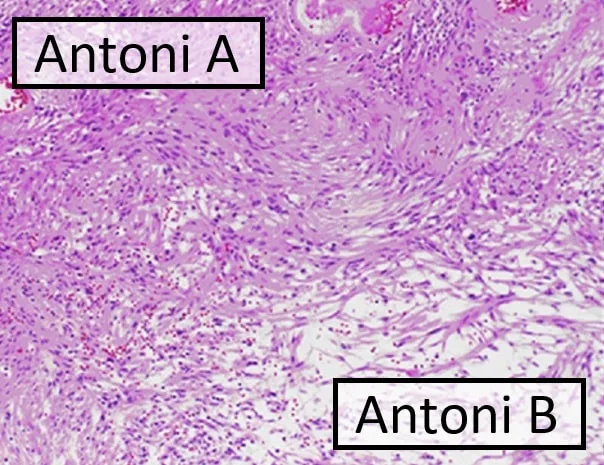
(1) Antoni A consists of densely packed elongated cells with nuclei arranged in a palisade pattern; (2) Antoni B is characterized by a loose organization of cells with small microcysts.
Manifests symptoms related to nerve compression (cranial nerve VIII compression results in patients experiencing ipsilateral hearing loss, tinnitus, and vertigo), seizures, headaches, nausea and vomiting, and other indications of elevated intracranial pressure.
Therapy
Tumor removal surgery.
The prognosis is favorable.
Neurofibromatosis type 2 is linked to bilateral auditory schwannomas.
Pineal tumors typically affect young males aged 10 to 40. They exhibit Parinaud syndrome, which includes paralysis of upward gaze resulting from injury to the pretectal and superior colliculus, obstructive hydrocephalus due to compression of the aqueduct of Sylvius, and endocrine problems related to compression of the hypothalamus.
Typically noncancerous growths originating from Schwann cells.
Pathology: Gross Encapsulated masses, frequently with cystic regions, typically found in the cerebellopontine angle, where they might compress cranial nerve VIII (acoustic schwannoma).
Microscopic: Two patterns of growth:
(1) Antoni A consists of densely packed elongated cells with nuclei arranged in a palisade pattern; (2) Antoni B is characterized by a loose organization of cells with small microcysts.
Manifests symptoms related to nerve compression (cranial nerve VIII compression results in patients experiencing ipsilateral hearing loss, tinnitus, and vertigo), seizures, headaches, nausea and vomiting, and other indications of elevated intracranial pressure.
Therapy
Tumor removal surgery.
The prognosis is favorable.
Neurofibromatosis type 2 is linked to bilateral auditory schwannomas.
Pineal tumors typically affect young males aged 10 to 40. They exhibit Parinaud syndrome, which includes paralysis of upward gaze resulting from injury to the pretectal and superior colliculus, obstructive hydrocephalus due to compression of the aqueduct of Sylvius, and endocrine problems related to compression of the hypothalamus.
0 Comments
