- Published on
Pathology - Second Degree Heart Block Type I
Pathophysiology
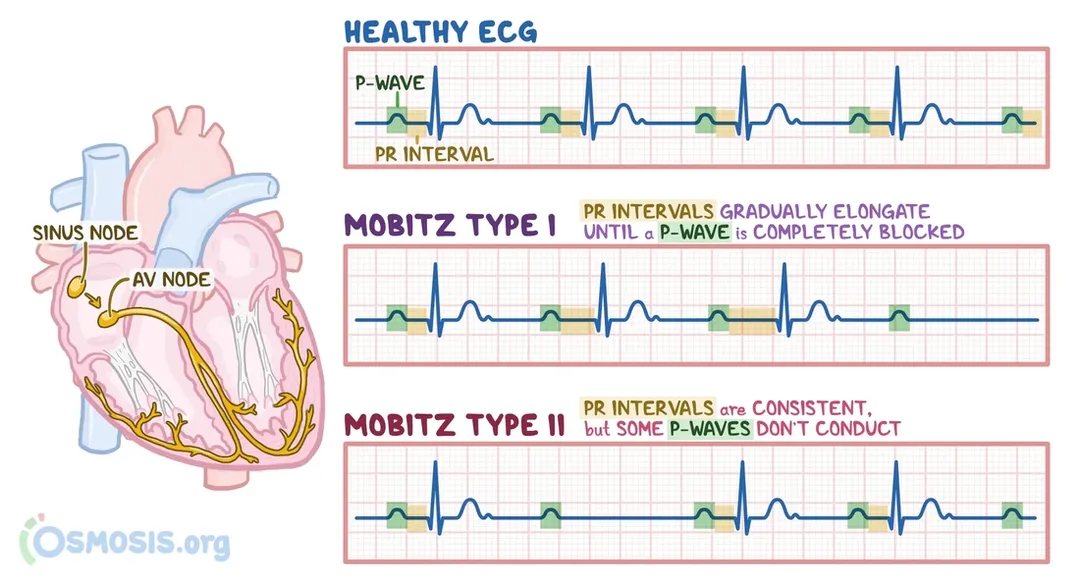
Second-degree AV heart block, Type I, sometimes referred to as "Wenckebach periodicity" or "Mobitz I." This disorder is brought on by an irregularity in the heart's AV node, which leaves the ventricles without receiving all of the atrial impulses. The vignette describes the ECG pattern, which is characterized by prolonged PR intervals that continue until no single atrial impulse is passed via the AV node, resulting in a "dropped" ventricular beat. After that, the PR interval "resets," and the cycle is repeated. For the condition to be accurately diagnosed, the atrial rhythm needs to be regular, or alternative atrial disorders need to be taken into account. Most of the time, this illness doesn't cause noticeable symptoms and doesn't need to be treated. In contrast, nonconducted atrial activity occurs in second-degree AV block, Type II (sometimes referred to as "Mobitz II"), in a far less predictable manner (i.e., no PR interval lengthening and resetting). Cardiovascular pacemaker therapy is recommended for the treatment of Type II second-degree AV block since it has the potential to quickly develop into total (third-degree) heart block. When the ventricles and atria beat separately, it is known as complete heart block, and it also requires the use of an implanted cardiac pacemaker.
Pathophysiology
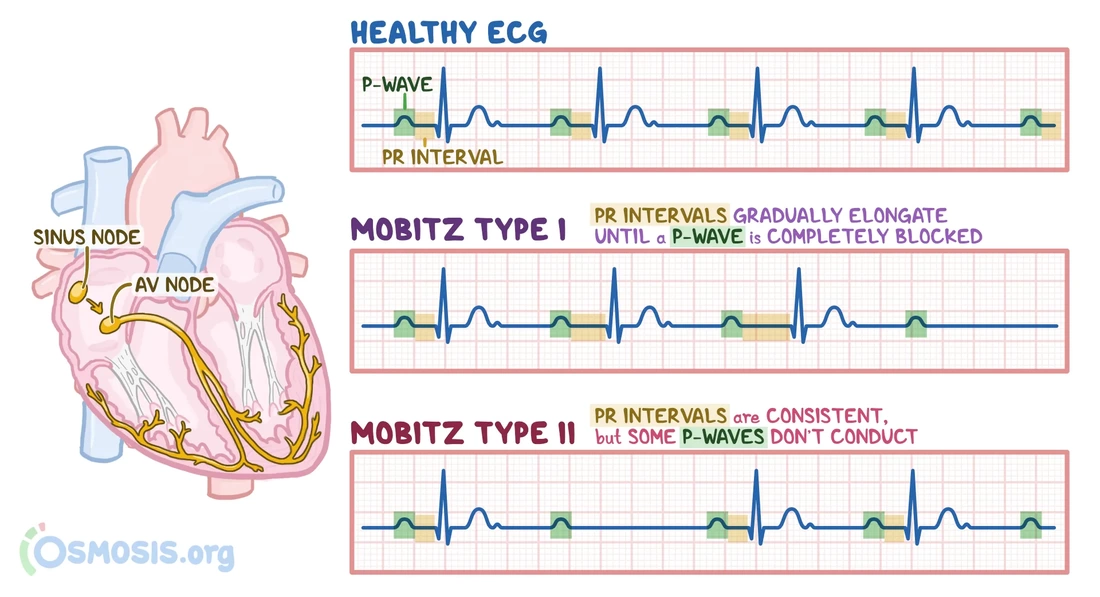
Second-degree AV heart block, Type I, sometimes referred to as "Wenckebach periodicity" or "Mobitz I." This disorder is brought on by an irregularity in the heart's AV node, which leaves the ventricles without receiving all of the atrial impulses. The vignette describes the ECG pattern, which is characterized by prolonged PR intervals that continue until no single atrial impulse is passed via the AV node, resulting in a "dropped" ventricular beat. After that, the PR interval "resets," and the cycle is repeated. For the condition to be accurately diagnosed, the atrial rhythm needs to be regular, or alternative atrial disorders need to be taken into account. Most of the time, this illness doesn't cause noticeable symptoms and doesn't need to be treated. In contrast, nonconducted atrial activity occurs in second-degree AV block, Type II (sometimes referred to as "Mobitz II"), in a far less predictable manner (i.e., no PR interval lengthening and resetting). Cardiovascular pacemaker therapy is recommended for the treatment of Type II second-degree AV block since it has the potential to quickly develop into total (third-degree) heart block. When the ventricles and atria beat separately, it is known as complete heart block, and it also requires the use of an implanted cardiac pacemaker.
0 Comments
