- Published on
Pathology - Sjögren Syndrome
Secondary form is found in association with other autoimmune disorders (RA and SLE), and is caused by autoimmune destruction of the salivary and lacrimal glands. It is related with HLA-DR2 and -DR3.
primarily affects women in the age range of 40 to 60.
Lacrimal and salivary glands: Hyperplasia of ductal epithelial cells; eventual fibrosis and atrophy of tissue; perivascular and periductal lymphocytic infiltrate; lymphoid follicles may be observed.
may affect extraglandular organs like the kidney, lung, or central nervous system in addition to other exocrine glands.
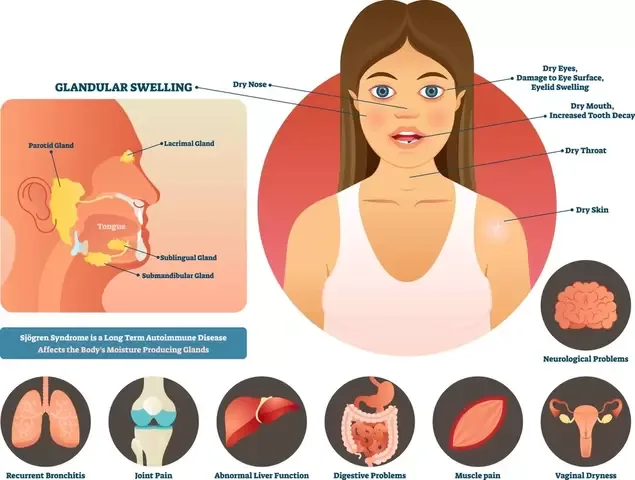
Dry mouth (xerostosmia) and dry eyes (xerophthalmia) are two symptoms of primary Sjogren syndrome. It's possible to see parotid enlargement. Additional symptoms include Raynaud phenomenon, reflux esophagitis, dry cough, and dry skin.
An elevated risk of B-cell lymphoma, polyneuropathy, interstitial pneumonitis, interstitial nephritis, or pulmonary hypertension are among the complications.
Results of the lab: anti-SS-A (Ro) and anti-SS-B (La) antibodies, as well as rheumatoid factor and other autoantibodies.
Treatment options for moderate-to-severe illness include artificial tears, topical or systemic steroids, and other immunomodulating medications.
Sicca syndrome is a type of Sjogren syndrome that solely manifests as dry lips and eyes.
In addition, it might be linked to vaginal dryness, reflux esophagitis, chronic bronchitis, and nasal dryness.
Secondary form is found in association with other autoimmune disorders (RA and SLE), and is caused by autoimmune destruction of the salivary and lacrimal glands. It is related with HLA-DR2 and -DR3.
primarily affects women in the age range of 40 to 60.
Lacrimal and salivary glands: Hyperplasia of ductal epithelial cells; eventual fibrosis and atrophy of tissue; perivascular and periductal lymphocytic infiltrate; lymphoid follicles may be observed.
may affect extraglandular organs like the kidney, lung, or central nervous system in addition to other exocrine glands.
Dry mouth (xerostosmia) and dry eyes (xerophthalmia) are two symptoms of primary Sjogren syndrome. It's possible to see parotid enlargement. Additional symptoms include Raynaud phenomenon, reflux esophagitis, dry cough, and dry skin.
An elevated risk of B-cell lymphoma, polyneuropathy, interstitial pneumonitis, interstitial nephritis, or pulmonary hypertension are among the complications.
Results of the lab: anti-SS-A (Ro) and anti-SS-B (La) antibodies, as well as rheumatoid factor and other autoantibodies.
Treatment options for moderate-to-severe illness include artificial tears, topical or systemic steroids, and other immunomodulating medications.
Sicca syndrome is a type of Sjogren syndrome that solely manifests as dry lips and eyes.
In addition, it might be linked to vaginal dryness, reflux esophagitis, chronic bronchitis, and nasal dryness.
0 Comments
