- Published on
Pathology - Squamous Cell Carcinoma of the Skin
Risk factors for this condition include long-term immunosuppression, tobacco use, arsenic exposure, excessive sun exposure (UV light), albinism, tar and ionizing radiation exposure, and faulty DNA repair pathways (e.g., xeroderma pigmentosum).
Precursor :
1)Actinic keratosis: precursor lesion; poorly defined, red, scaling lesion that occasionally forms a cutaneous horn; basal cell hyperplasia and cellular atypia; parakeratosis; presence of intercellular bridges.
2)A well-defined, red, scaling plaque or ulcerated nodule that is not penetrated by the basement membrane, cellular atypia throughout the entire epidermis, and hyperkeratosis with keratin pearls are all signs of in situ carcinoma
3)The hallmarks of invasive carcinoma include a significant anaplasia of sheets of neoplastic epidermal cells, keratinization with keratin pearls, and invasion into the basement membrane.
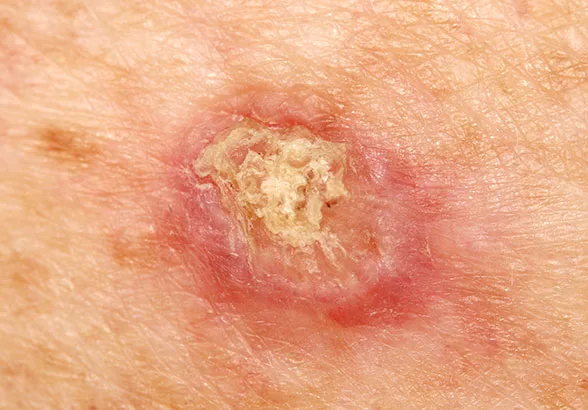
Small red, hard, ulcerating lump on the hands and face that develops after exposure to the sun.
Handling
surgical removal.
While less than 5% of cases metastasize (generally through lymphatic dissemination), surgery is typically curative in these cases, and the prognosis is not good.
Risk factors for this condition include long-term immunosuppression, tobacco use, arsenic exposure, excessive sun exposure (UV light), albinism, tar and ionizing radiation exposure, and faulty DNA repair pathways (e.g., xeroderma pigmentosum).
Precursor :
1)Actinic keratosis: precursor lesion; poorly defined, red, scaling lesion that occasionally forms a cutaneous horn; basal cell hyperplasia and cellular atypia; parakeratosis; presence of intercellular bridges.
2)A well-defined, red, scaling plaque or ulcerated nodule that is not penetrated by the basement membrane, cellular atypia throughout the entire epidermis, and hyperkeratosis with keratin pearls are all signs of in situ carcinoma
3)The hallmarks of invasive carcinoma include a significant anaplasia of sheets of neoplastic epidermal cells, keratinization with keratin pearls, and invasion into the basement membrane.
Small red, hard, ulcerating lump on the hands and face that develops after exposure to the sun.
Handling
surgical removal.
While less than 5% of cases metastasize (generally through lymphatic dissemination), surgery is typically curative in these cases, and the prognosis is not good.
0 Comments
